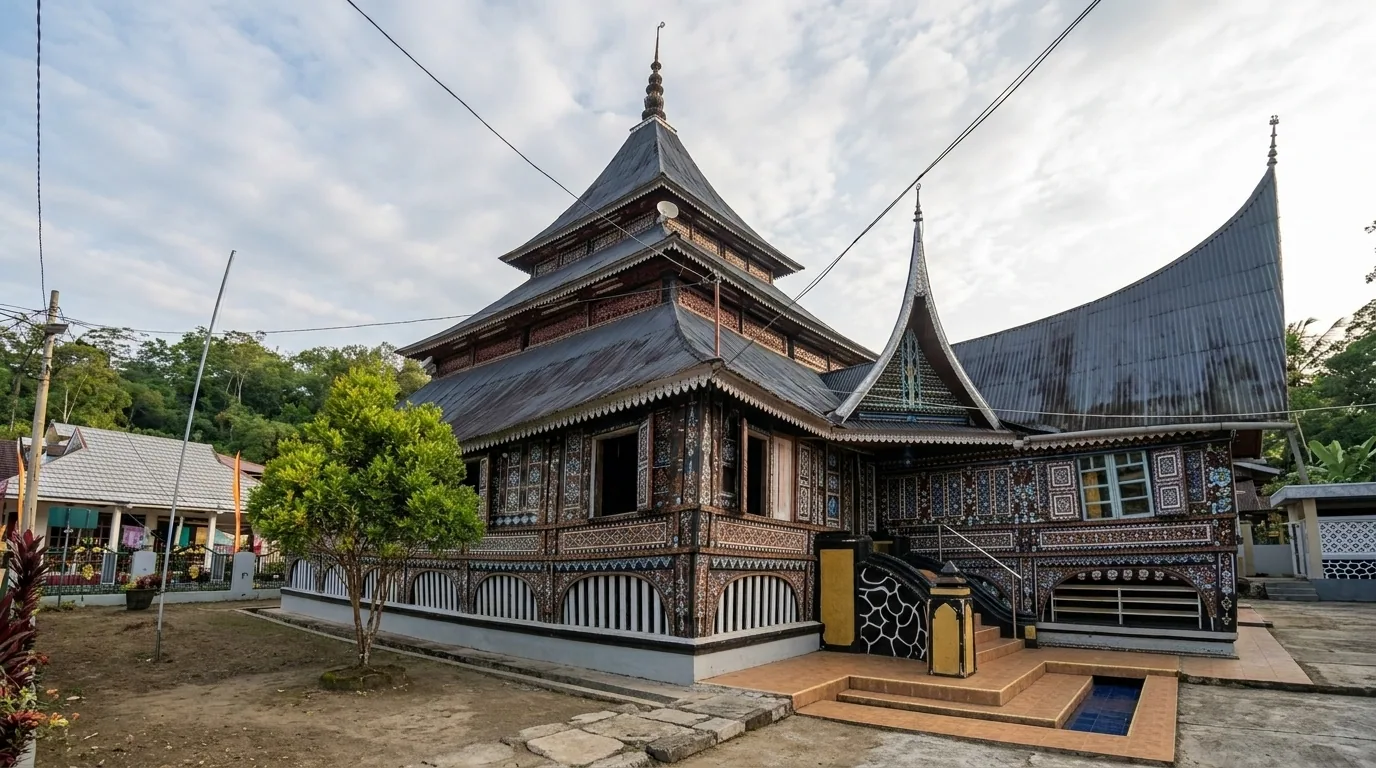
Masjid Asasi is a historic mosque in Sigando, Padang Panjang Timur, West Sumatra. Padang Panjang’s tourism authority describes it as the city’s oldest mosque and identifies its design as a traditional Minangkabau mosque form.
The building is recognizable by its three-tiered roof, a separate gonjong-shaped roof above the mihrab, and traditional ornament across its walls. Masjid Asasi also remains in religious use, so any visit needs to respect prayer and community activity.
How old is Masjid Asasi?
There is no single confirmed founding year.
Official tourism information from Padang Panjang notes two historical references. Local Kerapatan Adat Nagari records cite 1770, while the Balai Pelestarian Cagar Budaya (BPCB) Sumatera Barat has referred to 1702.
Because the official sources themselves differ, neither date should be treated as an undisputed founding year.
The mosque was originally known as Surau Gadang Sigando. According to Padang Panjang’s tourism information, the name Masjid Asasi came into use after 1930.
What should you notice in the architecture?
Masjid Asasi preserves several features documented in Padang Panjang’s tourism material as part of its traditional Minangkabau mosque architecture.
The three-tiered roof
The main roof rises in three levels.
Padang Panjang’s tourism guide describes the roof as pyramidal, with curved surfaces that help carry rainwater away from the structure. Its layered form is one of the clearest features to notice when viewing the mosque from outside.
The gonjong above the mihrab
The mihrab has a separate roof from the main structure.
Above it is a pointed gonjong, a roof form associated with Minangkabau architecture. Here, the gonjong appears within a religious building rather than on the Rumah Gadang structures more commonly associated with the form.
For broader context on Minangkabau architecture, adat, and local traditions, see our Minangkabau Culture Guide.
Floral ornament and wall details
Traditional decorative elements also appear across the mosque walls.
Padang Panjang’s tourism guide records floral motifs as part of the building’s Minangkabau ornament. These details can be seen across the wall surfaces and other decorative areas of the mosque.
What should visitors know before entering?
Masjid Asasi remains an active mosque. Padang Panjang city government reporting has documented congregational worship taking place there, including Ramadan prayers.
Worship and community use therefore take priority over sightseeing.
For its Sigando religious-heritage visits, Calvoya treats mosque access as dependent on local permission, prayer times, and community activity. Interior access should not be assumed simply because the building is also visited for its heritage value.
Dress modestly when visiting religious spaces. On its Sigando route, Calvoya advises visitors to cover their shoulders and knees; women may need a scarf when entering certain mosque spaces.
Ask before taking close photographs of worshippers or private spaces, and follow local guidance before entering prayer areas.
If the interior is not accessible at the time of your visit, the exterior still provides a clear view of the tiered roof, gonjong, and traditional architectural details.
How does Sigando fit into a Padang Panjang route?
Sigando can be combined with other cultural stops around Padang Panjang.
Calvoya currently includes Sigando’s religious heritage in its Kubu Gadang & Sigando Cultural Heritage Tour, alongside Kubu Gadang and a local dairy-farm visit.
For the village-experience side of Padang Panjang, see our Kubu Gadang, Padang Panjang guide.
FAQ
Where is Masjid Asasi?
Masjid Asasi is in Kelurahan Sigando, Padang Panjang Timur, Padang Panjang, West Sumatra.
How old is Masjid Asasi?
The exact founding year is uncertain. Official Padang Panjang tourism information cites 1770 from local adat records and 1702 from BPCB Sumatera Barat.
Is Masjid Asasi still used as a mosque?
Yes. Masjid Asasi remains in religious use, and local government reporting has documented congregational worship taking place there. Visitors should expect prayer and community activity to take priority over sightseeing.
Calvoya can include Sigando and Masjid Asasi in a custom West Sumatra journey when religious heritage, Minangkabau architecture, and Padang Panjang are part of the route.