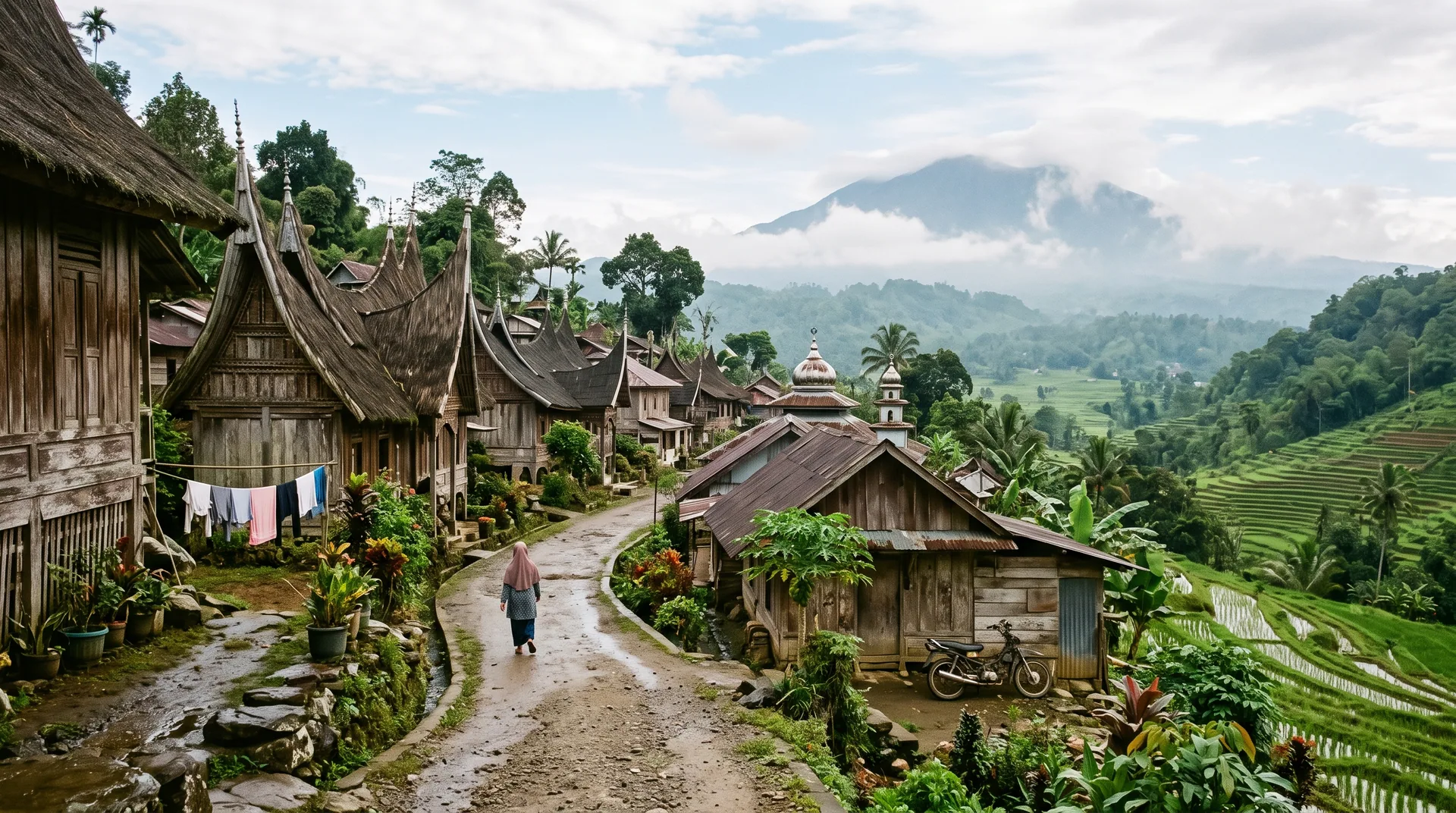
Nagari Tuo Pariangan lies in Tanah Datar on the slopes of Mount Marapi. The village is known for its older houses, religious sites, terraced fields, and place in Minangkabau cultural memory.
Pariangan remains a living settlement rather than an open-air museum. Homes, places of worship, village roads, agricultural land, and local businesses continue to serve the community.
Is Pariangan Village worth visiting?
Visit for a living village setting
Works well for
Travelers interested in older houses, village streets, religious architecture, and local history.
Keep in mind
Pariangan remains an inhabited village, and private homes and compounds are not automatically open to visitors.
Explore with local context
Works well for
Visitors who want to understand the stories connected with Pariangan’s historical sites.
Keep in mind
Local interpretation is useful for places whose significance is not immediately visible.
Include it in a Tanah Datar route
Works well for
Travelers visiting Batusangkar or continuing through the highlands of Tanah Datar.
Keep in mind
Pariangan fits naturally into a wider day in the surrounding area.
Why is Pariangan known as Nagari Tuo?
In Minangkabau tambo, Pariangan is associated with ancestral origin narratives and is known as Nagari Tuo.
The name reflects an important part of Minangkabau cultural memory. It should not be read as proof that every part of Minangkabau history began in one place. Pariangan’s significance lies in the traditions and stories connected with the nagari, as well as the inhabited village setting that visitors can experience today.
For broader context on adat, rumah gadang, family structure, and local etiquette, read the Minangkabau culture guide.
What to see in Pariangan Village
Village lanes and older houses
Walking through Pariangan reveals sloping streets, older houses, and residential compounds that remain in daily use.
Not every old building is a designated heritage site or a rumah gadang. Some are private family homes, and their age or architectural history may not be clear from the road.
The village setting allows visitors to see how homes, religious buildings, shared spaces, and agricultural land sit within one inhabited nagari. These relationships are easier to notice on foot than during a brief roadside stop.
Mesjid Tuo Pariangan and nearby surau
Mesjid Tuo Pariangan and the nearby surau add religious and architectural context to the village. They are also among the places included in a guided heritage walk listed through the village tourism profile.
These buildings should be approached as places of worship and community importance. Visitor access should follow current local guidance and any activities taking place at the time.
Their position within the residential area is part of their significance. They remain elements of village life rather than detached monuments.
Historical sites along the village walk
A guided Pariangan Heritage Walk may include Balai Saruang, Batu Lantak Tigo, Prasasti Pariangan, Mesjid Tuo Pariangan, and nearby surau.
Several of these places are difficult to understand from appearance alone. A local guide can identify them and explain how their stories are understood within Pariangan.
Visitors walking independently can still explore public village roads and see parts of the settlement. Local interpretation becomes more useful when the visit focuses on sites whose historical meaning is not immediately visible.
The highland setting
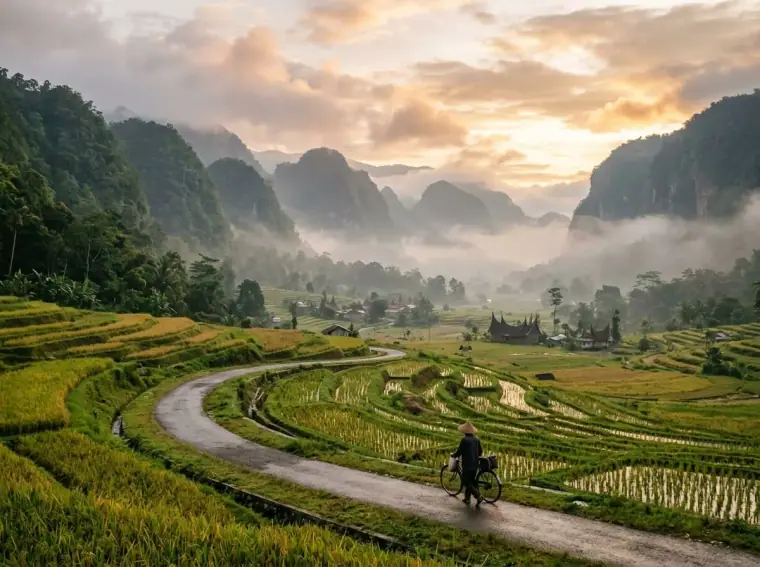
Pariangan sits within a highland landscape of slopes, settlement areas, and terraced fields. Views across the surrounding countryside vary with the weather and agricultural cycle.
The fields remain working agricultural land rather than dedicated visitor areas. Their appearance changes through planting, growing, and harvesting periods, so the landscape may differ from photographs seen online.
How to explore Pariangan Village
Visitors do not need a guide simply to walk along public village roads. Local interpretation becomes useful when the visit includes historical sites whose names and stories are difficult to identify independently.
A guided Pariangan Heritage Walk is listed through the village tourism profile. Confirm guide availability and meeting arrangements before planning the day around it. Routes and activities listed online should not be assumed to operate every day.
The West Sumatra transport guide compares practical ways to reach villages and cultural sites outside the main cities.
How to visit Pariangan respectfully
Pariangan is home before it is a visitor destination. Keep entrances and village roads clear, ask before photographing people at close range, and seek permission before entering houses, courtyards, places of worship, or cultivated land.
Wear modest clothing around religious sites and keep noise low near homes and prayer spaces. When access is unclear, ask rather than assume.
These simple habits allow visitors to explore the village without treating private or religious spaces as unrestricted attractions.
How much time do you need in Pariangan?
A few hours is usually enough for a focused walk through the village, the mosque area, and several historical sites visible from the public route.
Allow longer when a guided heritage walk or another arranged community activity is part of the visit. Guide availability and activity schedules should be confirmed in advance.
Pariangan does not need to fill an entire day for most travelers. Its setting is better suited to an unhurried visit than a rushed roadside stop.
How Pariangan fits into a West Sumatra route
Pariangan fits naturally into a day passing through the Batusangkar and Tanah Datar area.
Travelers combining the village with the nearby palace can read the Pagaruyung Palace guide for context on its reconstructed architecture and museum setting.
Calvoya can place Pariangan within a custom West Sumatra journey based on the hotel sequence, available time, and wider Tanah Datar route.
FAQ
Is Pariangan Village worth visiting?
Yes, especially for travelers interested in older houses, religious architecture, village landscapes, and Minangkabau cultural history.
Is Pariangan really the most beautiful village in the world?
Pariangan appeared in a 2012 feature on 16 picturesque villages. It is more accurate to say that the village was included in that selection than to call it the single most beautiful village in the world.
Why is Pariangan called Nagari Tuo?
In Minangkabau tambo, Pariangan is linked to ancestral origin narratives and is known as Nagari Tuo. The name belongs to cultural memory and historical tradition rather than a fully settled archaeological conclusion.
Can you visit Pariangan without a guide?
Yes. Visitors can walk along public village roads independently. A guide is useful for identifying historical sites and explaining their local context.
How long should you spend in Pariangan?
A few hours is enough for a focused visit. Allow longer when a guided walk or arranged community activity is included.