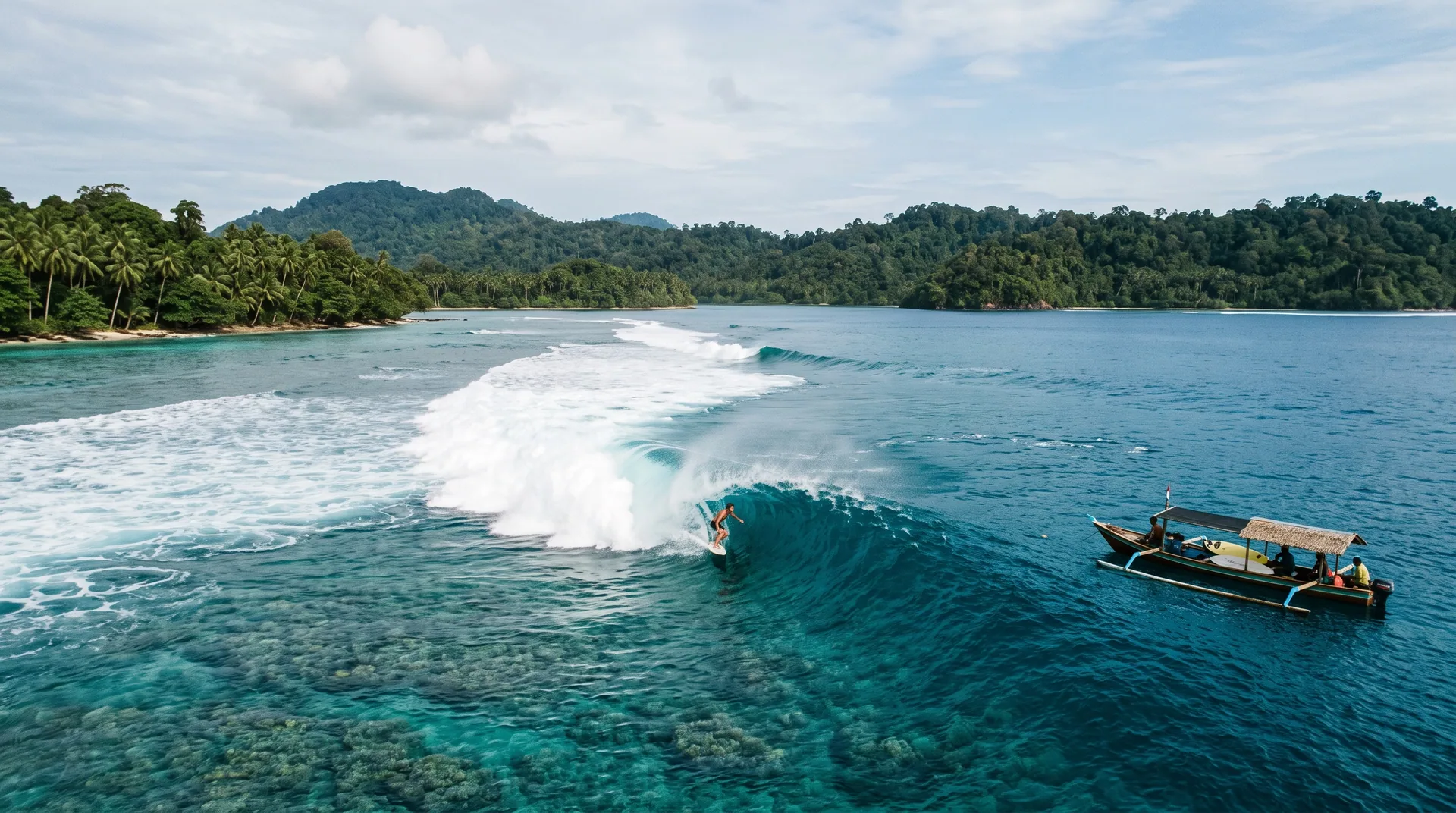
Planning a Mentawai surf trip starts before choosing a famous wave or a resort with a good view.
Your travel dates influence the kind of surf you may encounter. Your actual surfing ability affects which breaks make sense. Where you stay determines which waves are practical to reach each day. Then the whole plan still has to connect with Padang, boats, board bags and your onward travel.
For a first trip, the most useful order is simple:
choose the travel window → assess your surf level honestly → choose a surf zone and stay style → build the Padang logistics around those decisions.
If you are still deciding whether Mentawai fits your wider Indonesia trip, Calvoya’s Mentawai destination guide gives the broader destination context.
Start With the Trip You Want, Not the Wave You Know
Mentawai has four principal islands — Siberut, Sipora, North Pagai and South Pagai — plus many smaller islands. That geography matters, but island names alone are not enough for surf planning.
A better first question is:
What kind of surf trip are you trying to have?
Someone looking for a comfortable land base with several boat-accessible breaks needs a different plan from a group of experienced surfers wanting to move through the archipelago on a liveaboard charter.
Likewise, two accommodations both described as being in “Mentawai” may give you very different access to the waves you actually want.
This is why booking accommodation first and researching the surf later can be an expensive planning mistake.
When Is the Mentawai Surf Season?
Mentawai receives surf beyond one narrow season, but April to October is widely treated as the main surf season. May through September generally falls within the stronger peak period, while the months outside the main season tend to bring a different balance of swell consistency and conditions.
A practical way to think about the year is:
- April–May: Main season is underway. A useful window if you want strong Mentawai surf without assuming you need the largest peak-season conditions.
- June–September: Core peak-swell period. Powerful reef surf becomes a more important consideration when choosing breaks and matching the trip to your surf level.
- October: Still within the commonly cited April–October surf season, while conditions begin moving toward the broader shoulder-season pattern.
- November–March: Surf remains possible, but swell consistency and conditions differ from the main season. Choosing the right camp and nearby wave options becomes especially important.
The important point is that month does not determine difficulty by itself.
Wave size, swell direction, period, wind, tide and the individual reef all matter. A manageable wave on one reef can be very different from a heavy nearby break on the same day.
Do not plan a trip on the assumption that “September is intermediate” or “July is advanced.” That is too simplistic for Mentawai.
Is Your Surf Level Suitable for Mentawai?
Mentawai has surf for different levels, but many of the waves that made the islands famous are reef breaks requiring real experience.
Telescopes and Macaronis can suit experienced intermediate to advanced surfers depending on conditions, while Lance’s Right is a much more consequential reef wave.
That makes the word intermediate too vague to use on its own.
If you are a beginner
Mentawai is not the obvious place to book your first-ever surf lesson simply because a resort advertises waves for different levels.
There are friendlier waves and some operators accommodate developing surfers. Beginner opportunities can exist when conditions are suitable. But the specific break, tide, swell size, coaching and reef exposure all matter.
If you are still learning to paddle into unbroken waves independently, speak to the camp or operator before paying a deposit. Ask which specific waves they realistically use for someone at your level and what happens when those waves are unsuitable.
If you call yourself intermediate
Describe what you can actually do rather than relying on the label.
Can you paddle into unbroken waves without assistance? Are you comfortable duck-diving in a busy lineup? Can you control your direction immediately after takeoff? Have you surfed reef before? Are you comfortable when the surf becomes overhead? Can you identify a safe entry, exit or channel and return to the boat independently?
Those answers are more useful to a surf guide than the word “intermediate.”
A confident intermediate can have an excellent Mentawai trip, but the correct accommodation, surf zone and swell window matter much more than chasing the hardest-known waves.
If you are advanced
An advanced surfer has a wider range of options, including more consequential reefs and stronger swell windows.
That still does not make local knowledge irrelevant. Individual breaks respond differently to swell direction, wind and tide.
Choose a Surf Zone, Not Just an Island
Mentawai is long enough that saying “we are staying in Mentawai” tells you very little about your daily surfing.
The useful question is:
Which group of waves can this accommodation or boat reach efficiently?
Northern Mentawai and Playgrounds
The northern surf zone commonly called Playgrounds contains a dense collection of reef breaks around the small islands near southern Siberut and northern Sipora. Breaks in this broader area include E-Bay, Nipussi, Bank Vaults and Scarecrows, with several wave types and ability requirements concentrated within a relatively compact zone.
This density is one reason land-based surf accommodation can work well here.
But do not stop at “the resort is in Playgrounds.”
Ask which waves are actually close, what boat is used, how long typical surf transfers take, whether more than one boat operates, and how groups are divided when surfers want different breaks.
Accommodation position inside a strong surf zone can still change your daily routine significantly.
Sipora and Central Mentawai
Sipora illustrates why the island name alone can be misleading.
Telescopes is associated with the northwest side of Sipora, while Lance’s Right lies on the island’s eastern side farther south. They are not simply two waves sitting outside the same beach.
If a property says it is “on Sipora,” find its exact location and ask which surf area it normally accesses.
Tuapejat in North Sipora is also an important arrival point, but arriving on Sipora does not mean every famous Sipora wave is immediately outside the port.
Pagai and the Southern Mentawai
Farther south, the Pagai islands form another distinct surf area.
Macaronis Resort, for example, is located on Siniai Island just off North Pagai. Its published access route uses Sikakap before an additional speedboat transfer to the resort. That is a useful example of why your surf base determines the logistics rather than the word “Mentawai” on the booking page.
The farther your chosen base moves from the main arrival chain, the more important it becomes to understand every transfer before fixing flights.
Land-Based Surf Camp or Surf Charter?
This is one of the biggest structural decisions in a Mentawai trip.
Neither option is automatically better.
A land-based stay
A surf camp or resort gives you a fixed place to sleep and a consistent daily base. Depending on the property, surf boats then take guests to waves within the surrounding zone.
This style often makes more sense if you value a proper room, routine, space off the water, or are traveling with a partner or family who may not surf every session.
Its limitation is geographic. Your practical wave selection is shaped by where the property sits and how far its boats normally operate.
That is why Calvoya’s accommodation guidance recommends looking at Mentawai stays through location, wave access and transfer logistics, rather than room photographs alone.
A surf charter
A charter is effectively a mobile surf base.
Its main advantage is movement. Charter operators can change location as swell and wind change instead of returning to the same accommodation each day. Routes are generally condition-dependent rather than fixed, with boats repositioning between surf areas when appropriate.
That mobility comes with a different kind of trip: you are living aboard, sharing space, following the boat’s operating schedule and spending many days with the same group.
A charter can make sense when surfing is overwhelmingly the priority and the group is comfortable with boat life.
A land camp may work better when the holiday needs to satisfy more than surfing.
How Many Days Should You Allow?
Count usable surf days, not only nights shown on the flight itinerary.
Padang arrival, an overnight buffer, the main crossing, onward boat transfers and the return journey all consume time.
Roughly six to seven days including Padang logistics can work for a short surf trip, but more time generally makes a remote-island trip less pressured because every transfer is not critical.
So a nine-day holiday does not automatically mean nine days of surfing.
Before booking, write the trip out as a sequence:
arrival in Padang → buffer if needed → island/charter transfer → surf stay → return transfer → Padang buffer → onward flight
Only then count how many full surf days remain.
That number is more useful than the total duration printed on your international ticket.
Build the Logistics Backwards From the Surf Base
Padang is the practical mainland gateway for Mentawai travel. From there, the onward arrangement depends on whether you are joining a charter, using a ferry connection, or transferring to a specific camp or resort.
Do not choose your Padang flight first and assume everything offshore will fit around it.
Instead, confirm:
surf base or charter → required island connection → Padang departure requirement → suitable Padang arrival → international/domestic flights
The same logic applies on the return.
Ferry and boat schedules are operational information and can change. For that reason, this article does not reproduce a timetable that may be wrong by the time you travel.
For the transport chain itself, including Padang arrival, port connections, board bags and buffer nights, use Calvoya’s dedicated guide: How to Get to Mentawai from Padang.
Your Board Bag Is Part of the Transport Plan
A surfboard bag is not just sporting luggage in Mentawai.
Its dimensions and weight can affect airport handling, vehicle choice in Padang, port movement and the final transfer to a camp or boat.
Before confirming the trip, tell the operator:
- how many board bags you have;
- approximate bag dimensions;
- how many boards are packed;
- total travelers and other luggage.
That five-minute conversation can prevent a surprisingly awkward transfer day.
Check the Current Mentawai Surf Levy
Mentawai has a local surfing recreation levy, so include it in the trip budget rather than treating it as an unexpected arrival cost.
At the time this article was reviewed in September 2026, Mentawai Regency Regulation No. 1 of 2024 remained in force, with the published rate for foreign surfers listed at Rp2,000,000 per person per visit.
Because payment procedures and regulations can change, verify the current amount and collection process with your operator shortly before travel.
Do not rely on an old surf-forum post or an old resort brochure for this.
Traveling With Someone Who Does Not Surf?
The best surf base is not automatically the best base for a couple or family.
If a non-surfer is joining, ask what the property is like while the surfers are away.
Does it have a comfortable beach or pool? Are snorkeling, paddling or other activities available? Is there somewhere comfortable to spend a slow day? How long are surf boats normally away? Is the accommodation itself somewhere your partner would choose even without the waves?
Some land-based resorts are designed for this kind of mixed trip. Others are essentially functional bases for people who intend to surf all day.
What to Confirm Before Paying a Deposit
Before committing to a camp, resort or charter, make sure you can answer these questions:
- Where exactly is the accommodation or boat based?
- Which surf zone does it normally operate in?
- Which breaks are realistically used for your surf level?
- How are surfers of different abilities handled?
- What boat access is included?
- What is the complete transfer sequence from Padang?
- Are transfer dates fixed or flexible?
- What board-bag information is required?
- What happens if sea conditions or transport changes disrupt the planned transfer?
- Which transfers, levies or other costs are not included?
- What emergency arrangements does the operator have?
- If a non-surfer is coming, what can they realistically do during surf sessions?
A good operator should be able to answer these clearly.
A Practical Mentawai Surf Trip Planning Sequence
The easiest way to avoid booking the trip backwards is to follow this order:
1. Choose your travel window.
Decide whether you are deliberately targeting the main season, peak swell months or a quieter shoulder-season trip.
2. Describe your actual surfing ability.
Use specific skills and previous reef experience rather than simply saying beginner, intermediate or advanced.
3. Decide what kind of surfing you want.
Heavy barrels, high-performance waves, more forgiving walls and mixed-ability options may point toward different breaks and bases.
4. Choose the surf zone.
Think about Playgrounds, Sipora or the southern Mentawai as different operating areas rather than one interchangeable destination.
5. Choose land camp or charter.
Match the stay style to your group, comfort expectations and appetite for mobility.
6. Confirm the exact offshore logistics.
Know how you get from Padang to the actual accommodation or boat, not merely to “Mentawai.”
7. Build your flights around the confirmed island plan.
Remote-island transport should be the fixed point. Your mainland connections should give it enough margin.
That order will not guarantee perfect waves. Nothing can.
It will, however, make the trip far more coherent.
Planning Mentawai as Part of a Wider West Sumatra Trip
Mentawai can work on its own, or it can sit before or after a mainland journey through West Sumatra.
The mistake is trying to connect the islands directly to a tightly timed onward itinerary.
Extra care around remote-island returns matters, and unnecessarily tight onward flights after Mentawai are best avoided. A Padang buffer can also give you somewhere practical to reorganize boards and luggage before continuing inland or flying onward.
If you already know your approximate dates, surf level, group size and board-bag details, Calvoya’s Journey Designer can help work out how the Mentawai section connects with Padang and the rest of your route without forcing it into a fixed package.
The essential principle is simple:
choose the right surf trip first, then build the transport around it — not the other way around.