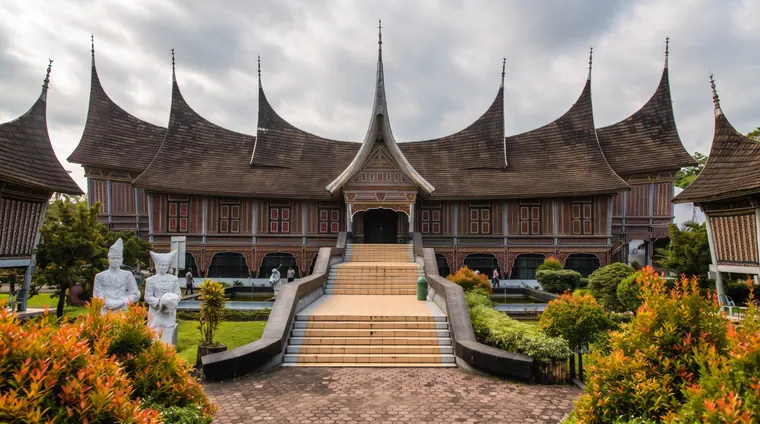
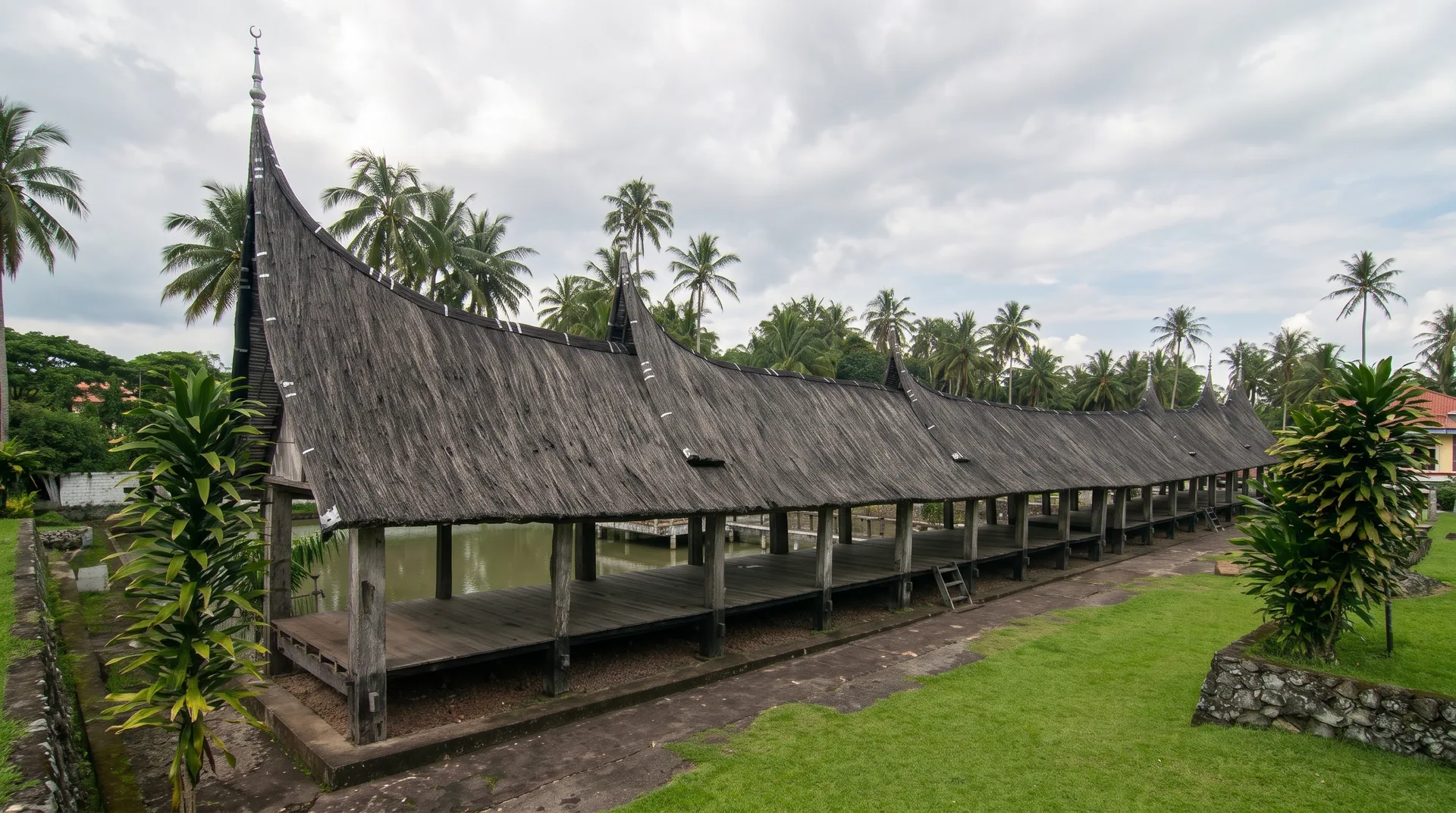
Balairung Sari Tabek is a historic open-sided adat meeting hall in Nagari Tabek, Pariangan District, Tanah Datar Regency, West Sumatra. Beneath its long, traditionally shaped roof is a raised wooden platform associated with meetings of Minangkabau customary leaders.
Unlike a Rumah Gadang, the hall was not designed as an extended-family residence. And unlike Istano Basa Pagaruyung, it is not a reconstructed palace museum. Its importance lies in a different question: what did a place for customary discussion look like?
For travelers already exploring Tanah Datar, Balairung Sari can be a worthwhile short heritage stop. The strongest experience is understanding the building’s layout and social purpose, not expecting a scheduled adat ceremony.
What Is Balairung Sari Tabek?
A balairung is a hall associated with gatherings and deliberation. Balairung Sari Tabek is also called Balairung Panjang, referring to its long form. The Tanah Datar tourism inventory identifies it as a place associated with meetings of Minangkabau customary leaders.
In this context, adat refers to inherited customary institutions and practices. Musyawarah means discussion or deliberation, while mufakat refers to reaching agreement. These ideas help explain why a meeting hall belongs in a guide to Minangkabau heritage alongside houses, mosques and village settlements.
Balairung Sari is a historical place for customary deliberation. Calling it a ‘parliament’ may be a convenient comparison, but it should not be mistaken for an institution with the same legal structure or procedures as a modern state legislature.
Where Is Balairung Sari Tabek?
The site is in Nagari Tabek, Kecamatan Pariangan, Kabupaten Tanah Datar, in the wider Batusangkar cultural area. Its location is independently listed by the Tanah Datar branch of Indonesia’s statistics agency as a historical and cultural tourism site in Tabek.
The administrative wording can be confusing. Nagari Tabek is not Nagari Tuo Pariangan, although both are in Pariangan District. Nor is Balairung Sari the same as Balai Saruang, a separate heritage site in Nagari Pariangan. Tabek Patah, in Salimpaung District, is another distinct location.
Search for the full name Balairung Sari Tabek and confirm the final approach with a driver or local contact. Published distances from Batusangkar vary, and a regency-wide attraction listing is not a substitute for a precise meeting point.
What Did the Hall Mean for Adat Deliberation?
Balairung Sari is associated with meetings of penghulu, or Minangkabau customary leaders. Local documentation describes deliberation involving customary representatives and, for some gatherings, the participation of niniak mamak and bundo kanduang.
This gives the site a function that differs from an ancestral family house. Here, the architectural story centres on assembly, seating and discussion rather than bedrooms or household organization.
That does not mean every Minangkabau community held every decision in this hall. Nor should a visitor assume that a historical meeting arrangement describes how all customary governance works today. It is one documented place within a much wider tradition.
For the wider cultural context, read Calvoya’s Minangkabau Culture Guide.
What Makes Its Architecture Distinctive?
The hall’s most recognizable feature is its open-sided timber structure. A long roof with Minangkabau-style gonjong rises above timber posts and a raised platform, without the enclosing walls and domestic rooms of a typical house.
Published heritage descriptions identify ijuk, or sugar-palm fibre, as a traditional roofing material. The exposed posts and continuous platform give the building a clear horizontal rhythm and allow visitors to understand much of its form from outside, where viewing is permitted.
The design is consistent with its history as an assembly hall. Yet it would be too simple to insist that the absence of walls proves one political philosophy or guarantees that every historical meeting was open to everyone. The building’s architectural form and customary interpretation should be explained together, without turning either into an absolute rule.
Several sources give conflicting measurements for the hall’s total length and width. This guide does not use a single exact dimension or claim that every visible timber component is original. Buildings can be maintained and repaired over time.
The 17 Sections and Labuah Gajah
The Tanah Datar tourism inventory of the hall’s 17 sections describes eight sections on one side, eight on the other, and a central space where the floor is interrupted. The central division is called Labuah Gajah, also described as Labuah Kudo in another local inventory entry.
These are not 17 enclosed rooms. The ‘sections’ refer to the spatial arrangement of an open hall. The distinction matters because a description such as ‘17 rooms’ can mislead English-language readers into imagining walls and doors that the building does not have.
Local tradition associates the central gap with the arrival of important customary figures on elephants or horses. That is a recorded explanation of its historical symbolism, not independently verified evidence of a particular procession. Even without accepting every element of the narrative literally, the broken floor is an important detail for understanding the site.
How Do Bodi Caniago and Koto Piliang Fit In?
The inventory links the hall’s spatial interpretation with Bodi Caniago and Koto Piliang, two major kelarasan or customary traditions in Minangkabau historical accounts.
The local interpretation of Labuah Gajah connects the central floor opening with Koto Piliang and the level platform, without a raised anjuang, with Bodi Caniago. Another inventory entry describes seating traditions involving representatives from each side of the hall and arrangements for niniak mamak and bundo kanduang at certain gatherings.
These details are most useful when understood as the site’s recorded customary interpretation. They do not establish a universal rule about which Minangkabau groups always sat where, or prove that either tradition maps neatly onto modern political labels such as ‘democratic’ or ‘aristocratic’.
If this aspect interests you, a knowledgeable local interpreter can explain what the hall’s arrangement means in its own community context.
How Old Is Balairung Sari Tabek?
Balairung Sari is widely described in regional publications as a hall with a history extending back several centuries. The Tanah Datar regional profile gives an age of more than 300 years, while other accounts differ on the period of construction.
Local tradition associates the building with Datuak Tantejo Gurhano, a figure remembered in stories about early Minangkabau architecture. His role belongs to the historical and customary accounts surrounding the site; a precise construction date has not been established by the records used here.
For that reason, avoid claims that the hall was built in an exact year, that its present roof is entirely unchanged from that period, or that it is definitively the oldest surviving meeting hall in Indonesia. The supported description is a historic meeting hall with a longstanding local architectural and adat tradition.
Is Balairung Sari Tabek a Heritage Site?
Yes. Government tourism and planning records identify Balairung Sari Tabek as a historic cultural site in Tanah Datar, and archaeological research discusses it as a surviving adat meeting hall.
Some secondary heritage lists cite a 2010 ministerial decree for the property. However, a current primary registry entry establishing its precise national ranking was not confirmed for this guide, so the article does not claim a rank-specific legal status or reproduce a decree number as settled fact.
Heritage recognition also does not mean visitors may freely climb onto the platform, touch the old timber or enter restricted areas. Follow the instructions of anyone responsible for the site.
What Can Travelers Expect to See?
The most dependable reason to stop is the exterior architecture: the long roofline, repeated supporting posts, raised floor and visible open-sided construction. The central gap, if visible from a permitted position, adds another layer of meaning once you know the local explanation.
There may be information on site or someone able to explain its history, but this should not be promised as a permanently staffed museum service. Similarly, accounts of customary gatherings do not mean a meeting will be in progress when you arrive.
If a community event is taking place, respect the people using the hall. Ask whether viewing or photography is appropriate. A visit remains meaningful even when you see only the structure and its setting.
Is It Worth a Stop From Batusangkar or Pariangan?
It can be, particularly if you are already spending time in Tanah Datar and want to understand the role of customary assembly. The geographic relationship is useful, but should not become an overconfident promise of a quick detour.
- Balairung Sari Tabek focuses on the historical setting of adat meetings.
- Istano Basa Pagaruyung near Batusangkar is a reconstructed palace and visitor museum, discussed in Calvoya’s Pagaruyung Palace Guide.
- Nagari Tuo Pariangan is an inhabited village with its own heritage context, covered in the Pariangan Village Guide.
Each answers a different question. The hall is not a substitute for the palace’s interpreted interiors or Pariangan’s village life. Nor is it necessary to fit all three into a short day just because they belong to the same regency.
If you are based in Bukittinggi, Calvoya’s Tanah Datar Day Trip Guide is a better starting point for deciding which cultural sites deserve the available time.
How Much Time Do You Need?
Treat the hall as a focused cultural-heritage stop, not a full-day attraction. How much time you spend depends on the road approach, whether you can view the permitted areas and whether a knowledgeable host has been arranged.
If your main interest is architecture, looking carefully at the form may be enough. If you want an explanation of kelarasan, Labuah Gajah and customary seating, allow time for a conversation rather than a rushed photo stop.
There is no verified universal admission price, daily opening schedule, visitor guide service or exact on-site duration. Check these before building a tightly timed itinerary around the visit.
Practical Visiting Notes
Location: Balairung Sari Tabek, Nagari Tabek, Pariangan District, Tanah Datar Regency, West Sumatra.
Navigation: confirm the exact stopping point rather than confusing it with Nagari Pariangan, Balai Saruang or Tabek Patah.
Access: do not assume the raised platform or every area of the grounds is open; follow local signs and instructions.
Photography: ask before photographing people, customary activities or areas where access is unclear.
Comfort: plan for outdoor conditions and check walking or step access if someone in your party has mobility needs.
Timing: confirm local visitor arrangements where important, and allow flexibility for the wider Tanah Datar route.
Is Balairung Sari Tabek Worth Visiting?
Yes, if Minangkabau adat and historic timber architecture matter to your journey. Its open platform makes an otherwise abstract idea—the setting for customary deliberation—visible and easier to discuss.
It is less essential for travelers whose limited time is already committed to Pagaruyung, Pariangan or another main destination. A short, respectful visit with accurate context is better than adding the hall to an overfilled sightseeing list.
To include Balairung Sari within a personalized Tanah Datar cultural route, use Calvoya’s Journey Designer and identify the places you most want to understand. Any special access or hosted interpretation should be confirmed before the route is finalized.