Before arranging an introduction to silek Minangkabau, decide whether you want to watch, try some movements or learn about a community’s practice. Those are different requests. A performance can be worth seeing without being a lesson; a short visitor activity can be welcoming without being formal martial arts training.
This guide explains the distinctions and what to ask before building a West Sumatra day around an encounter. It does not confirm a teacher, school or session for your dates.
Silek Minangkabau and the wider pencak silat tradition
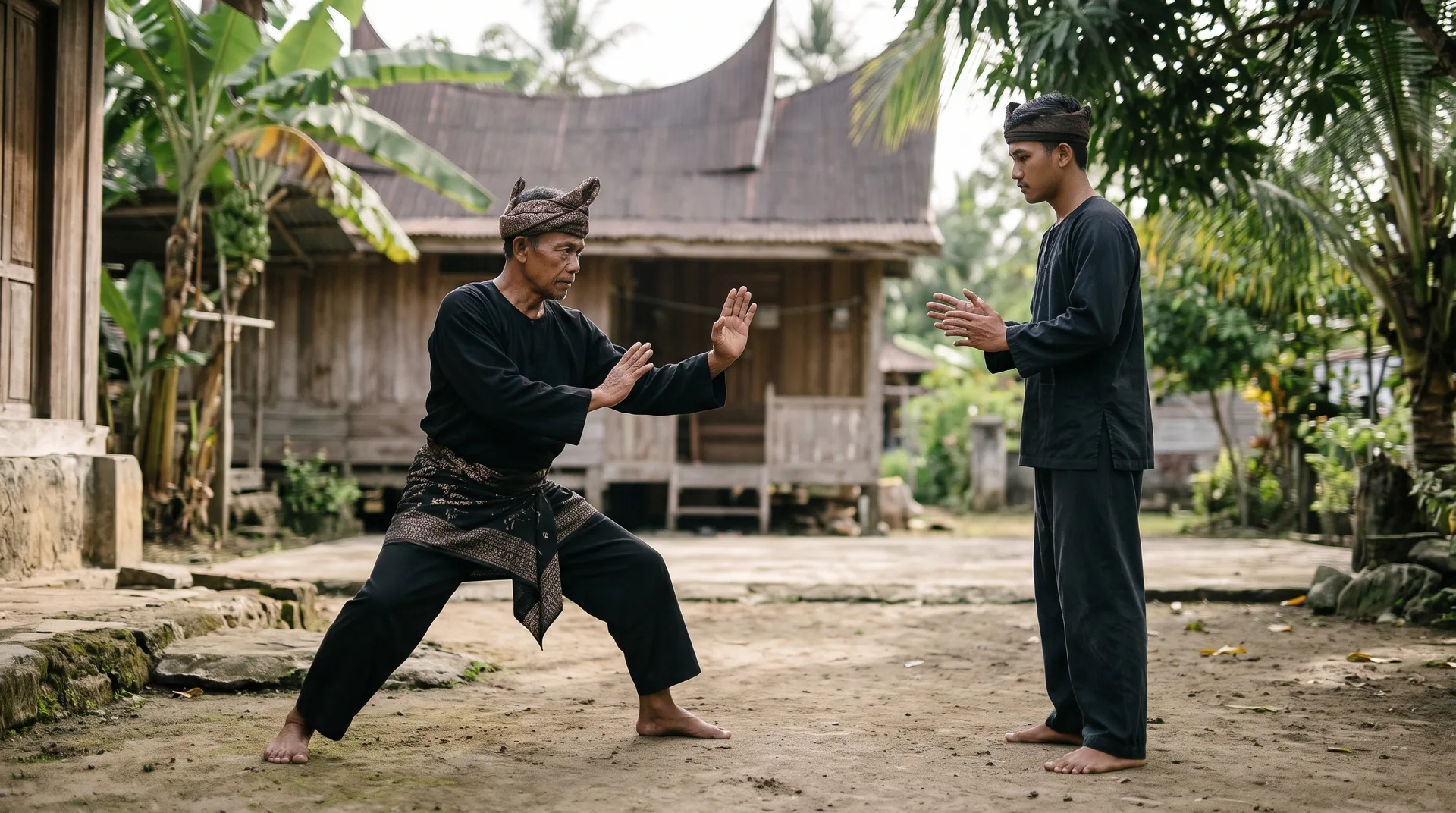
Silek is the Minangkabau term you will encounter alongside silat and pencak silat. The Indonesian National Commission for UNESCO describes a tradition with self-defense, artistic, sporting and mental-spiritual dimensions, and regional differences in names and practice.
Indonesia’s Traditions of Pencak Silat entered UNESCO’s Representative List of the Intangible Cultural Heritage of Humanity in 2019. That recognition concerns the wider tradition. It is not a separate UNESCO endorsement of an individual school, performance or commercial introduction.
Ask practitioners how they name and explain their own practice. One host’s account can help you understand that encounter without becoming a rule for every community in West Sumatra.
What a practice setting means
Research by Ediwar and colleagues, including arts researchers and a Minangkabau silat practitioner, discusses silek as martial and performance art. It describes sasaran as learning settings and refers to teachers as tuo silek.
These terms are useful context, not visitor-access instructions. A learning space is not automatically open to someone who arrives with a camera. Nor should a description of one training practice be turned into a promise about where, when or how every group trains.
If you have a particular interest, explain it in your request: perhaps how students learn, how a teacher understands restraint or how a movement changes when presented to an audience. Let the practitioner decide what they wish to discuss or demonstrate.
Why silek and randai are connected, but not interchangeable
A study of randai’s oral tradition identifies silek, narrative and song among its components. That provides a useful link between martial movement and Minangkabau performance, without making every silek demonstration randai.
Likewise, a randai-inspired circle activity is not necessarily a full randai performance. If a visitor program combines music and movement, ask how the host describes each element and what you will actually watch or do. You will learn more from that explanation than from assuming that all three names describe the same experience.
Choose the kind of encounter you want
Watch a presentation
Ask who is presenting, what the setting is and whether there is time for questions. You can choose to observe without expecting an invitation to join.
One place-specific example is Silek Lanyah in Kubu Gadang, Padang Panjang. The city tourism office describes a silat attraction in a wet, muddy rice-field setting. Its listing establishes the association, not a performance on a particular day. Our Kubu Gadang guide covers the wider village and its different visitor experiences.
Try an introductory activity
Ask what movements are involved, whether there is contact, who leads the activity and whether observing instead is possible. Discuss mobility limits or health concerns before booking; “beginner” is not an assessment of suitability for every participant.
Calvoya’s Minangkabau Arts Experience is a separate, by-request Kubu Gadang program. Its published description combines music, beginner silat movements and a randai-inspired activity. It describes the silat element as non-sparring and makes the format dependent on host and instructor availability. It does not establish that Silek Lanyah is included.
Ask about a practitioner-led conversation
If your interest is teaching or cultural knowledge rather than participation, say so. Ask whether an introduction to a willing practitioner can be arranged, whether interpretation is available and whether the proposed setting welcomes visitors. No particular community visit is confirmed here.
A conversation may be a better fit than a movement session for someone who wants context. It should still be agreed in advance, with the host’s time and boundaries respected.
Confirm the session, not just the destination
Before paying, ask for a description of the format, host, language support, duration and price. Check transport, clothing and footwear with the organizer, and ask what happens if the instructor becomes unavailable. For a mixed group, clarify whether some people can observe while others take part.
Keep permissions separate. Agreement to teach or demonstrate does not automatically include permission to record movements, photograph people closely or publish their images. Explain what you hope to record and accept any limits.
Once the activity is confirmed, allow time for it rather than squeezing it into a roadside pause. The exact meeting place and onward journey matter more than a generic duration assigned to the town.
Leave with context, not a claim of mastery
For the wider cultural setting, our Minangkabau culture guide introduces adat, family spaces and respectful travel. That background can help you put an arts encounter in context without expecting a short session to explain every aspect of Minangkabau life.
A first introduction to silek Minangkabau can be modest: watch carefully, ask what the host wants you to notice and participate only in what has been agreed. A short visit need not pretend to offer more than that.
If you would like to explore Minangkabau arts with Calvoya, take a look at our Minangkabau Arts Experience in Kubu Gadang. Tell us whether you prefer to observe or try beginner movements, and we can discuss a format that suits your group, subject to host and instructor availability.