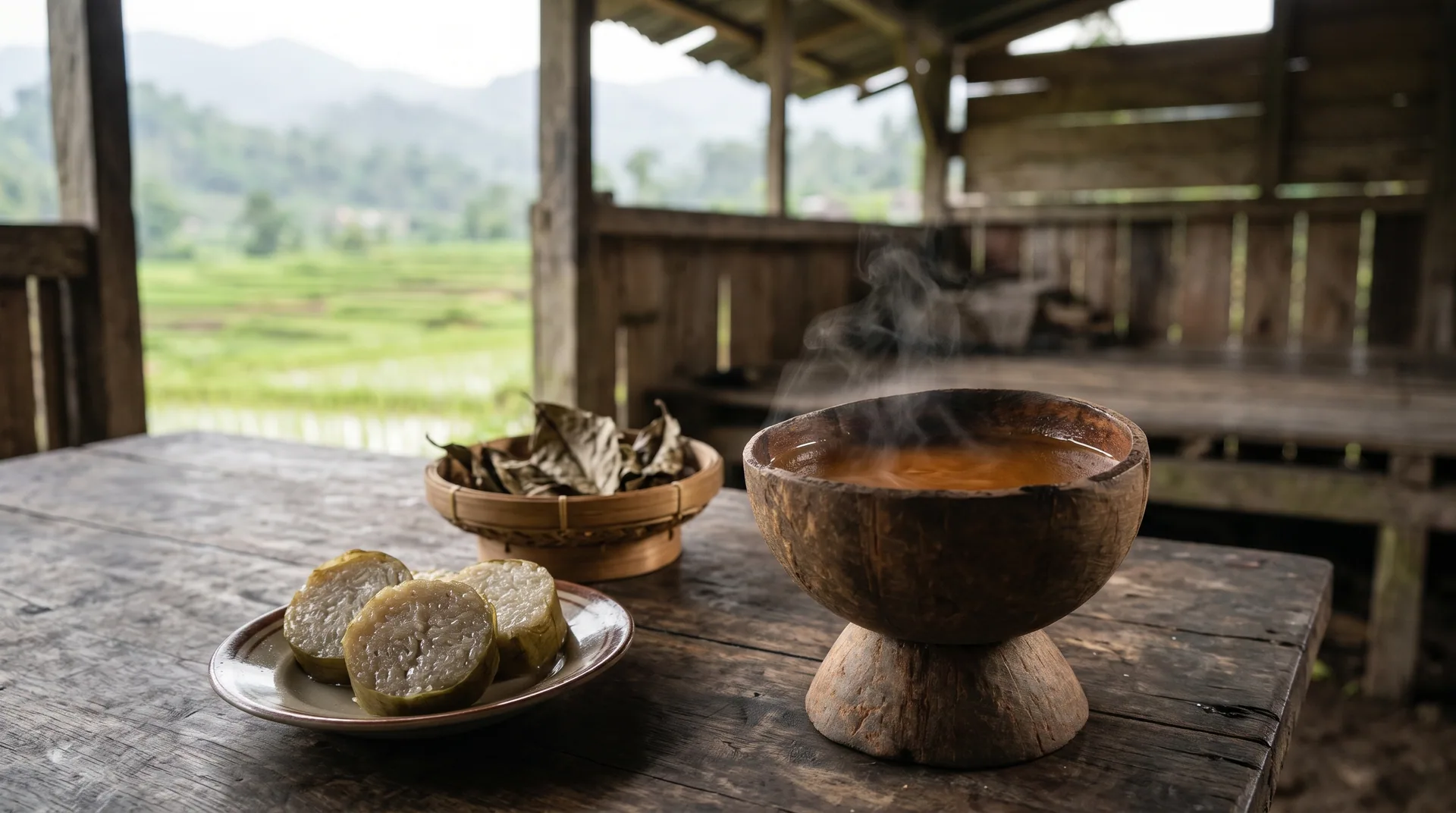
Kawa daun is a traditional West Sumatran drink made from prepared coffee leaves rather than roasted coffee beans. Often served warm in a coconut-shell bowl, it is a familiar part of the food culture encountered in parts of the Minangkabau highlands, particularly Tanah Datar.
For travelers, kawa daun is worth understanding before ordering. It can look like a dark cup of coffee, but the ingredients and preparation are different. You might taste it during a village visit in Pariangan or as a roadside pause between Padang Panjang and Bukittinggi. Neither setting automatically includes a demonstration of how the leaves are prepared.
This guide explains what kawa daun is, how the leaves are processed, what can reliably be said about its history, and how to include a tasting in a realistic West Sumatra journey.
What Is Kawa Daun?
Kawa daun is a drink prepared from the leaves of a coffee plant. The word daun means leaf in Indonesian. It is also called aia kawa in some local accounts.
The leaves are treated before use, commonly through drying with heat or smoke, and then prepared with water. The result is a leaf infusion rather than the roasted-bean drink commonly called coffee.
A 2018 study in the Journal of Ethnic Foods documented kawa daun production practices in West Sumatra. Another survey published by Andalas University examined how vendors prepared the drink in Tanah Datar, Agam and Lima Puluh Kota. These studies support describing kawa daun as a regional tradition with variation, not as one recipe belonging exclusively to a single café.
Is Kawa Daun Coffee or Tea?
It comes from the coffee plant, but it is not coffee brewed from roasted beans. Its preparation resembles a leaf infusion, so describing it as coffee-leaf tea can help international visitors understand what they are ordering. The leaves do not come from the tea plant, Camellia sinensis.
You may notice a flavor that recalls tea, coffee, or both. Processing and brewing change the aroma, color and strength, so there is no one tasting note that accurately describes every bowl. Do not expect it to taste exactly like espresso or ordinary filter coffee.
How Is Kawa Daun Made?
It helps to separate preparing the leaves from preparing the drink. Those are not the same stage.
Preparing the Coffee Leaves
The 2018 Journal of Ethnic Foods study documented several traditional treatments of the leaves, including drying above a cooking fire (pendiangan), smoking, and toasting over low heat. Its field observations often involved robusta coffee leaves, but that should not be turned into a claim that every producer uses the same coffee species.
The treatment can influence how dry, dark or smoky the finished leaves become. A vendor serving prepared kawa daun may obtain leaves from someone else, so the leaves are not necessarily processed at the stall where you drink it.
Brewing the Drink
The Andalas University survey documented three approaches among the vendors it studied: heating the leaves and water together, pouring hot water over prepared leaves, and adding the leaves to water that has already been heated. These are observed local practices, not a compulsory recipe or universal brewing instruction.
A visitor may see the finished infusion being poured into a bowl without witnessing the earlier drying or smoking process. If understanding leaf preparation matters to you, ask whether it can be explained or shown by a suitable host.
Why Is Kawa Daun Served in a Coconut Shell?
A recognizable presentation uses a halved coconut shell, often called a tempuruang or tampuruang, set on a simple bamboo support. West Sumatra’s regional tourism information documents this serving style and its association with small food stops.
The vessel is part of the drink’s familiar presentation, but not every seller is required to use it. Some may serve kawa daun in an ordinary cup.
There is also no single, securely documented explanation of why the coconut shell was first adopted. It is reasonable to describe the serving tradition; it would be misleading to invent a definitive origin story or a special health effect caused by the shell.
What Is the History Behind Kawa Daun?
A widely repeated account links kawa daun to Dutch colonial coffee cultivation and restrictions surrounding the coffee trade. In that story, local people prepared coffee leaves while the beans were controlled or reserved for commerce.
The historical setting is real: scholarship on the Minangkabau highlands documents coerced coffee cultivation during Dutch rule in the nineteenth century. But that does not prove kawa daun was first invented at a particular date because people were forbidden to drink the beans. The origin story is best presented as a popular account associated with the beverage, not an established single cause.
The drink’s longer history is more complex than one neat explanation, and historical research on coffee-leaf use in Sumatra deserves separate attention. For travelers, the most meaningful way to explore that history is to ask a local host how the drink is remembered and prepared in their community without expecting every storyteller to give the same account.
Is Kawa Daun an Indonesian Intangible Cultural Heritage?
Yes, under a specific registered name. Indonesia’s national intangible cultural heritage register records Kawa Daun Pariangan in Tanah Datar Regency under Ministerial Decree 372/M/2021.
The distinction matters. It is an Indonesian national Warisan Budaya Takbenda designation, not UNESCO inscription, and the entry’s exact name is Kawa Daun Pariangan. The registration does not imply that every seller elsewhere follows the same recipe or belongs to a single visitor program.
What Does Kawa Daun Taste Like?
The taste depends on the leaves and how they have been treated. A cup may be light or relatively strong, with earthy, slightly bitter or smoky notes. Some preparations evoke the aroma of coffee; others feel closer to leaf tea. These are possible characteristics, not a guaranteed flavor profile.
You may encounter kawa daun plain, sweetened or served with an addition. If you want to understand the base drink, ask whether it can be served without added sugar or milk.
It is also associated with simple food accompaniments. The regional tourism page describes enjoying it with fried snacks, while roadside accounts also pair it with lamang, glutinous rice cooked in bamboo. The pairing depends on what the seller offers; it is not an ingredient requirement.
Is Kawa Daun Caffeine-Free?
No such guarantee can be made. Coffee leaves can contain caffeine, and the amount in a prepared drink varies with the plant material and processing. A scientific review of coffee-leaf tea discusses caffeine as a relevant component, but it does not establish an exact caffeine dose for a particular bowl of traditional kawa daun.
If you need to avoid caffeine, do not assume kawa daun is a caffeine-free substitute. Claims that it cures illness or provides specific medical benefits should likewise not be treated as established evidence.
Where Can Travelers Encounter Kawa Daun in West Sumatra?
It is more useful to consider places where kawa daun is documented as part of local food or tourism culture than to publish a ranking of cafés that may change operators or hours.
Pariangan: Combine the Drink With a Village Visit
Nagari Tuo Pariangan, in Tanah Datar, is closely associated with the registered tradition of Kawa Daun Pariangan. The national tourism-village directory describes a rice-field walking experience that includes traditional refreshments and kawa daun.
That makes it a credible place to ask about a locally hosted tasting. It does not guarantee the listed activity or price is available on your chosen date, or that leaf preparation will be demonstrated. A visit should still focus on the village’s inhabited setting, with the drink as one possible addition. See Calvoya’s Pariangan Village Guide.
Tabek Patah: A Highland Context for the Drink
The official Desa Wisata Tabek Patah listing places the nagari in Salimpaung, Tanah Datar, and includes material featuring kawa daun and a leaf-processing shelter.
These references make Tabek Patah relevant for travelers interested in its local food culture. They do not establish a daily production demonstration, guided tasting or walk-in access to a private preparation site. If you want more than a drink, confirm the person hosting the visit and what can actually be seen.
Aie Angek: A Roadside Stop on the Padang Panjang–Bukittinggi Corridor
Nagari Aie Angek, in X Koto, Tanah Datar, lies along the wider road corridor between Padang Panjang and Bukittinggi. West Sumatra’s culinary tourism directory documents a lamang and kawa daun food stop in the area.
This is a practical kind of pause to consider when traveling the highland road. The listing is evidence of a named food business, not confirmation that it is open today or that leaf processing is demonstrated on request. Check the actual stop and opening arrangements before adding it to a fixed transfer. Calvoya’s Padang to Bukittinggi Route Guide explains the wider travel-day decisions.
How to Fit Kawa Daun Into Your Itinerary
From Bukittinggi: If your route already includes Pariangan or another part of Tanah Datar, ask whether a kawa daun tasting can fit alongside the village experience. Avoid collecting several distant food stops when the cultural visit is the day’s main purpose. Calvoya’s Tanah Datar Day Trip Guide helps with that balance.
Between Padang Panjang and Bukittinggi: A confirmed roadside seller in the Aie Angek area may be more practical than diverting to a different nagari solely for a drink. Make the stop conditional on your route and the group’s energy.
For a food-culture journey: A prepared drink and a demonstration of drying or smoking leaves are different experiences. Arrange the second explicitly if the process, rather than tasting, is your main interest.
Practical Tips Before Ordering
- Ask whether the drink is prepared from coffee leaves, and whether anything has been added.
- Ask for an unsweetened serving if you want to compare the base flavor, where available.
- Do not assume a coconut-shell bowl or a particular snack is provided at every stall.
- Confirm any named food stop or village-hosted activity before a date-specific itinerary is finalized.
- Ask permission before photographing vendors, preparation areas or people in a village setting.
For more regional dishes and ordering advice, use the West Sumatra Food Guide.
Frequently Asked Questions
Is kawa daun made from coffee beans?
No. It is made from prepared coffee leaves. The beans are used for conventional brewed coffee.
Is kawa daun the same as tea?
It is tea-like as a leaf infusion, but the leaves come from a coffee plant rather than the conventional tea plant.
Why is it served in a coconut shell?
Serving kawa daun in a coconut-shell bowl on a bamboo support is a documented regional practice. No single definitive historical explanation for its original adoption has been established in the sources reviewed for this guide.
Does kawa daun contain caffeine?
It can. The amount in a specific serving has not been established by the studies cited here, so do not assume it is caffeine-free.
Where should I try it?
Choose a stop that suits your route. Pariangan has a documented village-activity context, Tabek Patah has documented kawa daun-related cultural material, and Aie Angek has a documented roadside food-stop context. None is a guarantee of a currently available tasting or production demonstration.
Is Kawa Daun Worth Trying?
Yes, if you want to encounter a Minangkabau food tradition that uses a coffee plant in an unfamiliar way. It works particularly well as a small part of a Pariangan cultural visit or a realistic break on a highland road journey.
You do not need to claim you found the original vendor or visited the birthplace of the drink. A better experience is to ask what leaves were used, learn how they were prepared when the seller knows, and enjoy the beverage without turning a simple stop into an overpacked itinerary.
For a private Tanah Datar journey that includes local food and village culture, contact Calvoya with your dates and starting point. Any hosted preparation activity should be confirmed before being included in your plan.