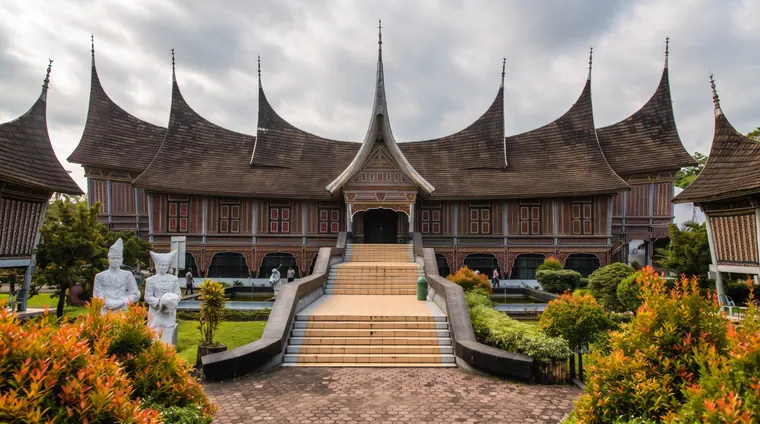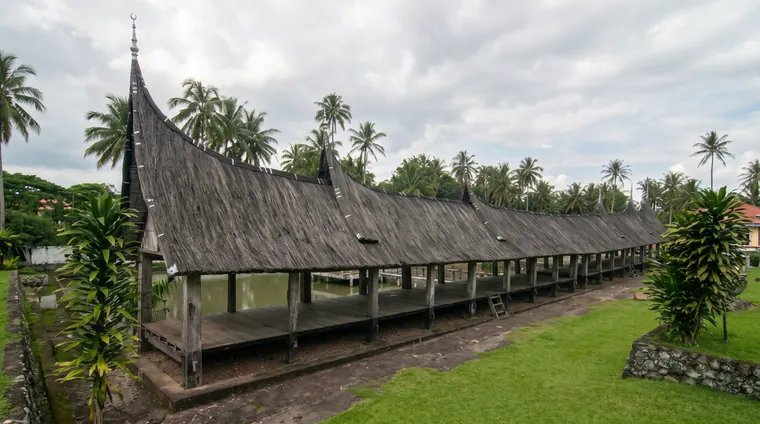
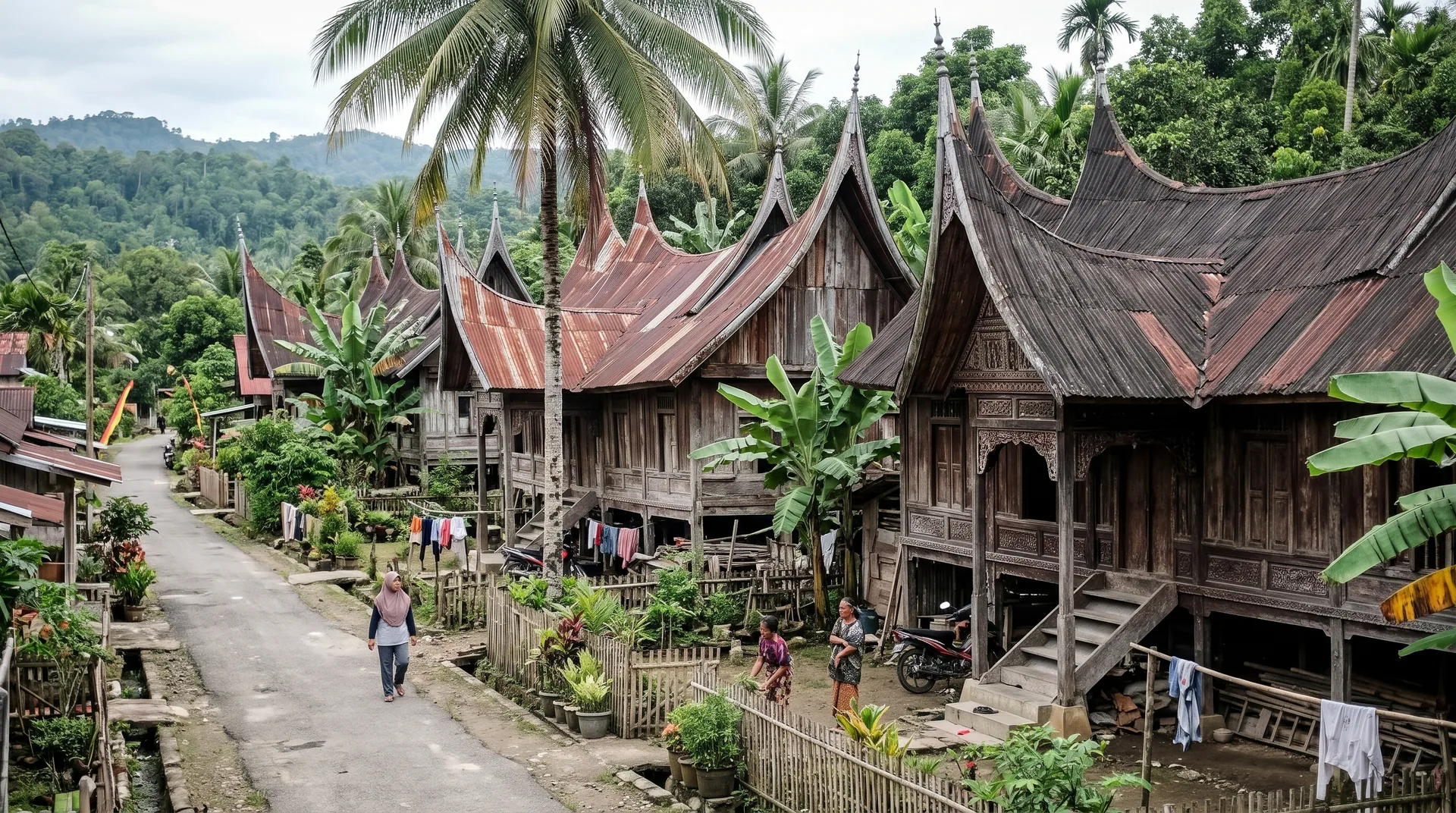
Perkampungan Adat Nagari Sijunjung is a traditional Minangkabau settlement in Sijunjung Regency, West Sumatra, where groups of Rumah Gadang form part of a community that is still inhabited. The experience is different from visiting a reconstructed palace or a museum: houses, family spaces, village roads and cultural traditions belong to the people who live here.
For travelers, the main questions are practical. What can you actually see? Can you stay in a traditional house? And does the village fit with Silokek or Sawahlunto? The answers depend less on a checklist of buildings than on your route and what local hosts can arrange.
What Is Perkampungan Adat Nagari Sijunjung?
The name refers to the traditional settlement associated with Nagari Sijunjung, Sijunjung District, Sijunjung Regency. Official tourism information gives its visitor address in Jorong Padang Ranah, and heritage descriptions also identify Tanah Bato.
The village is notable for a concentration of Rumah Gadang, the traditional Minangkabau houses associated with extended family and customary life. These houses are not identical to one another, nor should every house be assumed to serve the same purpose today. The important feature is the settlement as a whole, including the ways houses relate to each other, village lanes, agricultural surroundings and community institutions.
Indonesia’s official tourism-village directory lists a village walk, cultural offerings and homestays. That makes this an established visitor destination, not a guarantee that any particular activity or private interior will be available without arrangements.
Where Is the Traditional Village?
Perkampungan Adat Nagari Sijunjung is inland, in Sijunjung Regency. It is not in the city of Sawahlunto, the better-known highland base of Bukittinggi, or South Solok Regency.
The visitor-facing directory lists Jorong Padang Ranah, Nagari Sijunjung. The name in UNESCO’s heritage submission refers to Koto Padang and Tanah Bato, while the national cultural-heritage designation uses Padang Ranah and Tanah Bato. These are the terms used in the respective records; travelers should use the contact or map pin supplied by their host rather than try to resolve the different descriptions from a general map search.
This is a destination best considered within a Sijunjung-focused or longer eastern West Sumatra journey. A separate stop at Silokek, Sawahlunto or another town still requires its own road journey. No fixed driving time should be assumed without the actual starting point and route.
Is It a UNESCO World Heritage Site?
No. The UNESCO World Heritage Centre lists Traditional Settlement at Nagari Sijunjung on Indonesia’s Tentative List, with a submission date of 30 January 2015. A Tentative List entry identifies a property a country may consider for nomination. It is not inscription on the World Heritage List.
The UNESCO submission describes 76 traditional houses at the time. Indonesia’s tourism-village directory also reports approximately 76 Rumah Gadang. Those figures are useful historical and descriptive context, not a verified current count of occupied houses, accessible interiors or homestay rooms.
What about its Indonesian cultural-heritage status?
The settlement also has formal recognition within Indonesia. The government cultural-heritage record displays an earlier regency/city-level designation dated 17 April 2014. A later Ministry of Education and Culture list of nationally ranked heritage properties includes Perkampungan Adat Jorong Padang Ranah dan Tanah Bato Nagari Sijunjung under Ministerial Decree 186/M/2017, dated 6 July 2017.
The later national designation and the UNESCO Tentative List are different kinds of recognition. Neither means a family home automatically operates as a public museum.
Why Is This a Living Heritage Settlement?
Minangkabau society is known for a matrilineal kinship tradition, in which lineage and aspects of customary inheritance are connected with the maternal line. The UNESCO submission explains the relationship between Rumah Gadang, kin groups and the wider customary settlement.
Here, the heritage is not confined to a roof shape. It also includes the spatial relationship of family houses, meeting places, places of worship, fields and everyday village life. The settlement’s living character matters precisely because it is not frozen at one historical moment. Houses and households can change, and residents continue to have ordinary responsibilities unrelated to tourism.
If you primarily want to understand architectural features such as gonjong and rangkiang, read Calvoya’s Rumah Gadang architecture guide. This guide is about visiting this particular community.
What Can You Do in the Village?
Walk Among the Rumah Gadang
A walk through the permitted visitor areas is the most straightforward experience. From the village lanes, you can observe how multiple traditional houses sit within an inhabited settlement, rather than seeing one isolated showpiece.
A local host can add context about the village, houses and community traditions. Do not enter courtyards, stairs or interiors merely because a house looks historic or appears open. Those spaces may be private, and the appropriate permissions can vary between houses.
Ask About Weaving and Local Food
The national tourism-village directory documents songket weaving and foods including galamai (also written kalamai) and lomang in the village’s visitor offerings. These are useful ways to explore local skills and hospitality when arrangements are confirmed.
A weaving demonstration is not necessarily taking place throughout the day. An arranged cultural meal is also different from a permanently staffed restaurant. Ask which activity is actually available on the intended date, who hosts it and what the arrangement includes.
Learn About Bakaua Adat
Bakaua Adat is a documented local tradition connected with agricultural thanksgiving and communal life. The official tourism-village event description describes gatherings at Los Tabek and a communal makan bajamba meal.
It is not a daily performance. Unless the date and arrangements of a real event have been confirmed, visitors should expect to learn about the tradition rather than witness it. A local community practice should not be staged or advertised as a guaranteed attraction simply to complete an itinerary.
Can You Stay Overnight in a Rumah Gadang?
Homestays are advertised in the official tourism-village directory, which also includes individual homestay listings. That supports the possibility of a locally hosted stay.
It does not verify current vacancies, which houses are accepting guests, room privacy, bathroom arrangements, meal service, prices or booking terms. Some listings have incomplete or inconsistent pricing fields, so a displayed figure should not be treated as a confirmed quotation.
Ask the host to confirm the exact house, sleeping arrangements, bathroom access, arrival time, food, payment and any included activities. An overnight is worthwhile if staying within the settlement is part of your interest; it is not necessary for every visitor.
Perkampungan Adat Sijunjung vs Pagaruyung Palace
Istano Basa Pagaruyung in Tanah Datar is a reconstructed palace and museum, where visitors can focus on a monumental building and interpreted interiors. Its role as a destination differs from that of an inhabited family settlement.
Perkampungan Adat Nagari Sijunjung is about the grouping of traditional houses and their community setting. You may see more ordinary contemporary village life and fewer formal museum explanations. Which is better depends on the route and the kind of experience you want, not on a ranking of authenticity.
See Calvoya’s Pagaruyung Palace guide for that separate destination.
Is This the Same as Saribu Rumah Gadang?
No. Perkampungan Adat Nagari Sijunjung is in Sijunjung Regency. Saribu Rumah Gadang is a separate traditional-house settlement at Koto Baru, Sungai Pagu, South Solok Regency.
Their similar appeal does not make them nearby alternatives or parts of the same village. Travelers should choose according to their wider regional route rather than using the names interchangeably.
Can You Combine the Village With Silokek?
Yes, as a culture-and-landscape itinerary in the wider Sijunjung region. The Ranah Minang Silokek Geopark management website identifies the traditional settlement as part of the area’s cultural heritage.
The two places contribute different experiences:
- Perkampungan Adat Nagari Sijunjung: inhabited Rumah Gadang settlement, community traditions and potentially arranged cultural activities.
- Silokek: landscapes associated with the Batang Kuantan River, limestone formations and geological sites, with outdoor activities dependent on local operators and conditions.
They are not one compact attraction, and a heritage walk does not automatically connect with rafting, cave access or other activities at Silokek. Start with the available village host and your intended Silokek stop, then decide whether the combination deserves a longer regional stay.
What About Sawahlunto?
Sawahlunto offers a different historical focus: coal mining, industrial buildings, railway heritage and museums. It can make sense as a separate stage on a longer eastern or southern West Sumatra journey that also includes Sijunjung.
A possible planning sequence is to spend meaningful time in Sawahlunto, continue to the Sijunjung settlement with an arranged local visit, and visit a selected Silokek site as another stage. This is not a claim that all three can be covered thoroughly in one day. Museum access, road journeys, hotel location and local hosting arrangements all affect the pace.
Read Calvoya’s Sawahlunto travel guide for the mining-heritage part of the journey.
Should You Make a Short Visit or Stay Overnight?
A focused village walk works when the settlement is one stop in a Sijunjung itinerary and you chiefly want to observe the houses and their setting.
A hosted cultural visit is more suitable when the main purpose is meeting a local host, understanding community heritage, or taking part in an available food or craft activity.
An overnight homestay may make sense if a confirmed host offers the experience you want and staying nearby helps with the wider Sijunjung–Silokek route.
There is no reliable universal visit duration. Do not assume every Rumah Gadang interior can be toured, all activities can be performed on demand, or any particular package can be booked on the day.
Visiting a Living Community Respectfully
A heritage village is also a residential place. The most useful approach is simple: ask first, follow local guidance and distinguish public lanes from family spaces.
- Ask permission before entering a Rumah Gadang, private courtyard or residential area.
- Ask before photographing residents or their homes, particularly children and daily domestic activities.
- Respect prayer, customary gatherings and occasions that are not organized for visitors.
- Do not expect access to ceremonial objects, private rooms or cultural performances without an invitation.
- For a homestay, follow the household’s instructions and confirm facilities in advance.
For broader context on family, adat and visitor etiquette, see Calvoya’s Minangkabau Culture Guide.
Practical Planning Notes
Location: use Perkampungan Adat Nagari Sijunjung, with Jorong Padang Ranah, Nagari Sijunjung as a visitor-address reference. Confirm the precise meeting point with your host.
Host and activities: if you want more than an exterior walk, ask the tourism-village contact which guide, weaving activity, meal or homestay can be arranged on your date.
Access and fees: no single current admission charge or opening schedule was reliably established for every kind of visit. Obtain the relevant details from the local organizer before traveling.
Transport: plan the final village connection as well as the journey between regional towns. A private driver may simplify a multi-stop trip; independent travelers should verify local transport arrangements rather than assuming a town-to-town service reaches the settlement. See the Getting Around West Sumatra guide.
Weather and walking: prepare for outdoor village lanes and possible rain. Ask about the route if a traveler needs step-free access or has limited mobility.
Is Perkampungan Adat Nagari Sijunjung Worth Visiting?
Yes, for travelers who want to see traditional Minangkabau houses as part of a living settlement rather than as isolated architectural exhibits. The heritage recognition is documented, and official tourism sources describe locally hosted experiences. The actual visit should still be planned around permissions, available hosts and the wider route.
The village adds a valuable cultural dimension to a Sijunjung journey, especially when paired thoughtfully with Silokek’s landscapes or with a separate Sawahlunto heritage stage. It is less compelling as a rushed diversion from a short Padang–Bukittinggi holiday.
To explore a journey focused on Sijunjung culture and nature, use Calvoya’s Journey Designer and specify your dates, starting hotel, interests and whether an overnight stay matters. Local activities and access should be confirmed before the itinerary is finalized.
Come to understand a community and its heritage—not simply to collect photographs of traditional roofs.