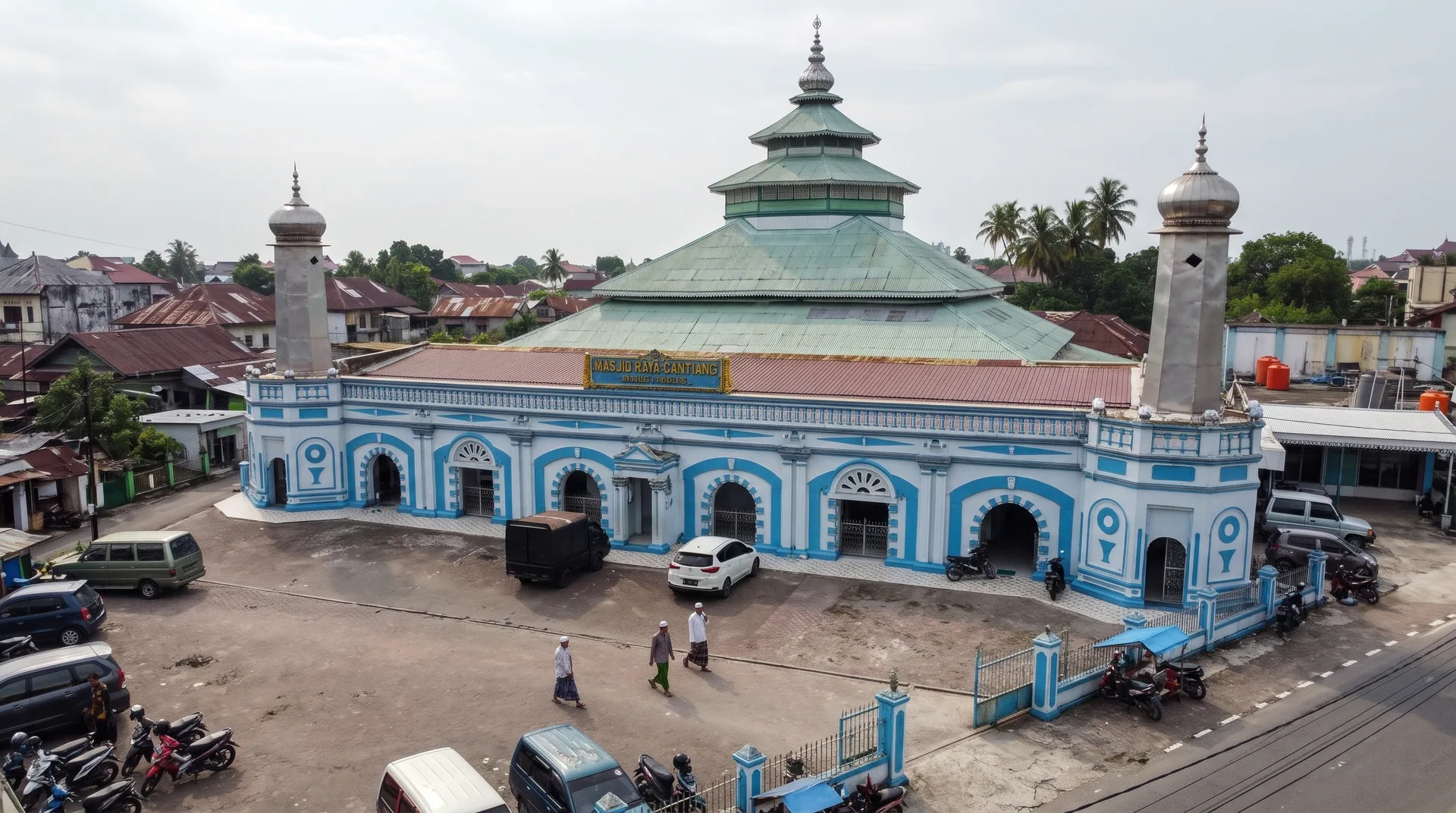
Masjid Raya Gantiang is a historic mosque in Ganting Parak Gadang, Padang Timur, Padang, West Sumatra. Its arched frontage, tiered central roof and minarets make it visibly different from the modern Grand Mosque of West Sumatra. Yet the building is not simply an architectural landmark: it remains an active place of worship.
For visitors interested in Padang’s Islamic history, Gantiang is worth considering as a focused heritage stop, particularly when you want to understand how a religious building has changed over time. An exterior visit is a more dependable expectation than an interior tour, which requires local permission.
What Is Masjid Raya Gantiang?
Masjid Raya Gantiang and Masjid Raya Ganting are two spellings used for the same mosque. The Indonesian government’s cultural-heritage register uses Ganting, while national tourism materials also use Gantiang. They should not be treated as two separate places.
The mosque stands in an established urban neighbourhood of Padang and continues to host prayers and religious activities. It is different from a museum: heritage recognition does not override the needs of worshippers or the authority of those caring for the building.
Why Is the Mosque Historically Significant?
The West Sumatra provincial government’s history describes the mosque’s development as a community undertaking. Its account names local religious and community figures, records land contributed as wakaf by members of the Chaniago community, and mentions financial support from merchants and Minangkabau religious leaders.
Those details help explain the mosque as a place sustained by local networks, rather than a monument commissioned solely by a ruler. They are details recorded in the government’s historical account, not a claim that every early event has been verified through surviving construction documents.
There is a separate, clearer legal fact. The national cultural-heritage database records Masjid Raya Ganting as a Bangunan Cagar Budaya Peringkat Kabupaten/Kota, designated under Decision No. 03 of 1998, dated 16 January 1998. That is an Indonesian regency/city-level heritage ranking, not UNESCO recognition or a national-rank designation.
How Old Is Masjid Raya Gantiang?
A single founding year would oversimplify its history. The provincial account describes an early timber-and-thatch structure around 1790, a more substantial construction effort beginning around 1805, and completion of that phase around 1810. Other published institutional accounts place its earliest origins earlier, so the date of a predecessor prayer space should not be confused with the construction date of the present building.
A careful description is that Masjid Raya Gantiang has a history associated with the late eighteenth and early nineteenth centuries, with later changes to its architecture and materials. It would be misleading to calculate the precise age of every visible part from 1790, 1805 or 1810.
Claims that it is definitively Indonesia’s oldest mosque, or occupies a precise national age ranking, require stronger comparative evidence than the sources reviewed for this guide.
What Makes Its Architecture Distinctive?
The Arched Frontage and Minarets
The most immediately recognizable view is the repeated arches across the front of the building, with minaret structures rising above the façade. These features give Gantiang a markedly different appearance from a smaller, predominantly timber-built mosque.
Descriptions of its architecture refer to regional and European-influenced forms. Such terms help describe visible design characteristics; they do not prove that a particular architect designed every arch or minaret, or that all the elements were built in one phase.
The Tiered Roof
Behind the frontage, the mosque’s central roof rises in multiple tiers. From a suitable exterior viewpoint, notice how the roof and its uppermost section relate to the longer, lower frontage. The combination is part of the building’s distinctive silhouette.
Avoid treating the roofline as evidence that Gantiang is a Rumah Gadang or that it has the same form as Padang’s modern grand mosque. These are different religious buildings with different architectural histories.
Interior Columns and Materials
The prayer hall contains supporting columns, and historical documentation records changes in floor and wall finishes. The provincial history describes replacement floor materials during the early twentieth century and later ceramic finishes added to structural surfaces and walls.
These changes make an important conservation point: a protected historic building is not necessarily made entirely of untouched original material. If you are permitted to enter, observe the space without touching vulnerable details or crossing areas being used for worship. Do not assume that a feature shown in an old photograph is still visible today.
A Living Mosque, Not a Museum
The national tourism portal identifies Gantiang as a mosque still used for worship. The Padang city government has also documented religious and community activities taking place here in 2026. This ongoing use is part of the site’s significance, not an obstacle to its heritage story.
Visitors may arrive during congregational prayer, preparation, cleaning or other activities. Religious use takes priority over sightseeing. A short exterior visit can still be rewarding when the prayer hall is unavailable.
Can Non-Muslims Visit Masjid Raya Gantiang?
The official sources reviewed do not establish a universal policy guaranteeing non-Muslim tourist access to the prayer hall. Being listed as a tourism destination does not itself grant unrestricted interior entry.
If you wish to see the interior for its architecture, ask a caretaker or mosque representative whether a visit is suitable at that moment. Accept any restrictions on entry, photography or particular spaces. The exterior remains the main option if permission is not given.
What Should Visitors Wear and How Should They Behave?
Dress modestly, with shoulders and knees covered, and follow any additional requirements communicated locally. Women should be prepared to cover their hair if requested before entering prayer areas. Remove footwear where instructed.
Keep your voice low, silence your phone and never interrupt worship. Ask permission before photographing worshippers or interior spaces. Friday congregational prayers and other busy religious occasions are not appropriate times for an unarranged architectural tour.
Travelers planning prayer stops elsewhere in the province can consult Calvoya’s Halal Travel Guide to West Sumatra.
Where Is the Mosque in Padang?
Masjid Raya Gantiang is on Jalan Ganting, Kelurahan Ganting Parak Gadang, Kecamatan Padang Timur, Kota Padang. Indonesia’s national tourism portal publishes the street address, although other heritage and travel references use different building numbers. Navigate using the full mosque name and check the destination pin rather than relying on a number alone.
It can fit into a Padang city day, but do not assume it is a natural walking extension of the Batang Arau old-town area. Your hotel, road crossings, traffic and the locations of your other stops determine whether a short vehicle transfer is more practical.
For the wider city context, use Calvoya’s Padang Travel Guide.
Gantiang vs the Grand Mosque of West Sumatra
Masjid Raya Gantiang is useful for understanding an older urban congregation and a building shaped by several historical periods. Its arched frontage, tiered roof and later modifications are central to that story.
The Grand Mosque of West Sumatra, on Jalan Khatib Sulaiman, is a modern landmark with a different Minangkabau-inspired architectural approach. See the separate Grand Mosque of West Sumatra Guide for its design and visiting arrangements.
Another historical comparison is Masjid Asasi Sigando, but that mosque is in Padang Panjang, not Padang City. Its dedicated guide covers a different building and route. None of these mosques needs to be ranked as the ‘best’; choose according to your architectural interests and actual itinerary.
Opening Hours, Renovation and Time to Allow
No confirmed sightseeing timetable, admission fee or regularly available heritage tour was established from the official information reviewed. Do not confuse prayer access with tourist visiting hours.
In March 2026, the Padang city government announced plans for renovation and historical interpretation. That announcement does not confirm whether works have started or finished. If entering the mosque or photographing the whole exterior is especially important, check whether any work or community activity affects access on your chosen date.
For most cultural itineraries, treat Gantiang as a short, respectful heritage stop rather than a scheduled museum visit. Allow additional time only if a suitable explanation or permitted interior viewing has been arranged.
Is Masjid Raya Gantiang Worth Visiting?
Yes, for travelers interested in Padang’s Islamic history, urban heritage or changing mosque architecture. The building provides a meaningful contrast with the city’s contemporary grand mosque, and its continuing religious role is part of what makes it significant.
If your time in Padang is limited, a carefully chosen exterior stop may be enough. If access or timing is uncertain, prioritize the places that fit the rest of your day without interrupting worship.
Visit Gantiang as a living mosque with a documented architectural history—not as a museum whose doors are automatically open for sightseeing.