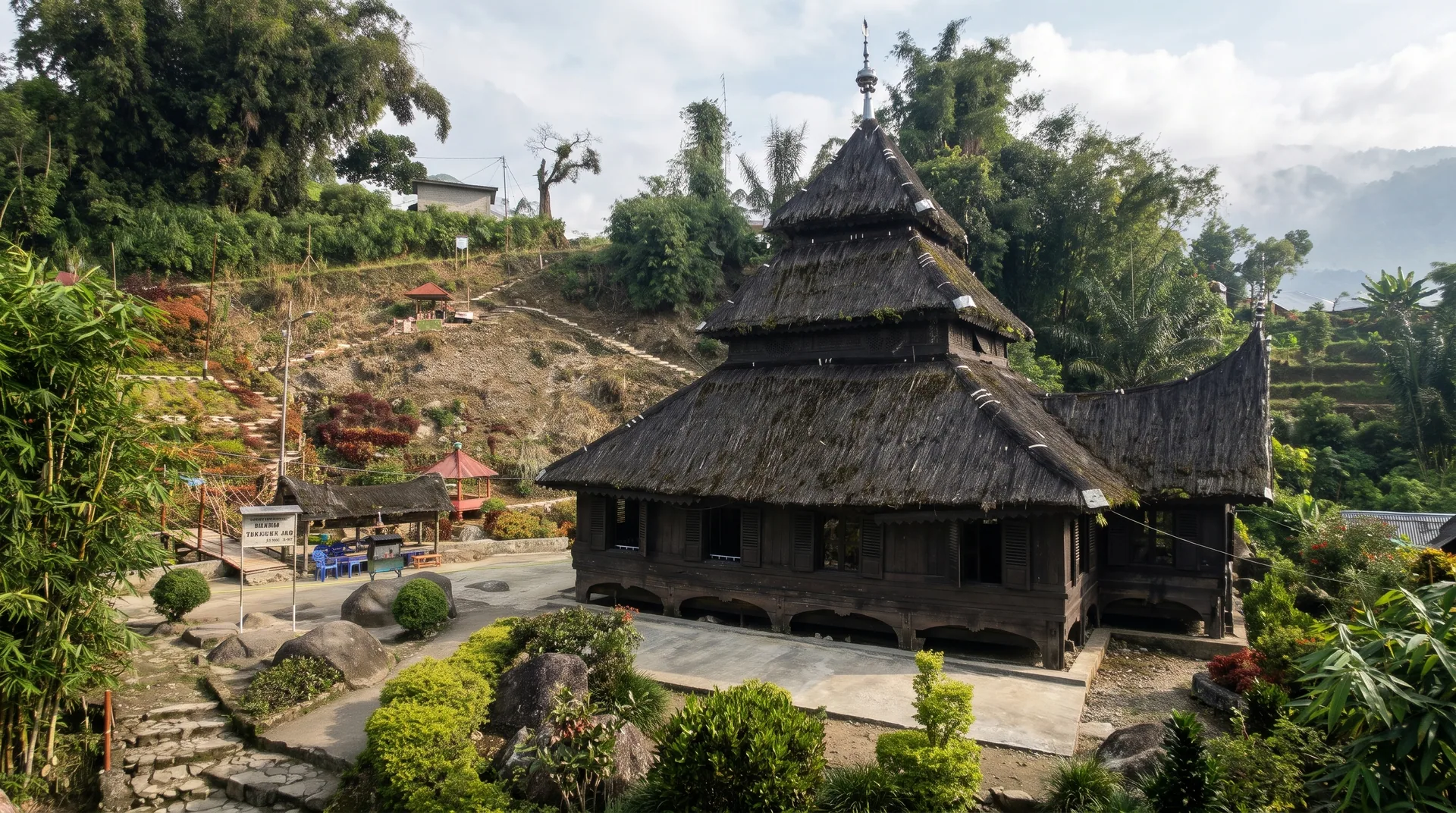
Masjid Tuo Kayu Jao is a historic wooden mosque in Jorong Kayu Jao, Nagari Batang Barus, Gunung Talang, Solok Regency, West Sumatra. Its three-tiered palm-fibre roof and timber construction make it an important example of traditional mosque architecture in the region.
For travelers, the question is not simply how old the building is. Is it worth stopping on the way from Padang to Alahan Panjang and the Twin Lakes? It can be, particularly if Islamic heritage or architecture interests you. But it remains a place of worship, and a worthwhile exterior visit should not be confused with guaranteed access to its prayer hall.
This guide separates the mosque’s documented heritage status from uncertain founding stories, then explains how to include it without overloading a Solok highland travel day.
What Is Masjid Tuo Kayu Jao?
The name is commonly rendered in English as Old Kayu Jao Mosque. It is a historic mosque, not a replica or a purpose-built cultural exhibition.
Indonesia’s national cultural-heritage database records Masjid Tuo Kayu Jao as a nationally ranked cultural-heritage building (Bangunan Cagar Budaya Peringkat Nasional), under decision PM.86/PW.007/MKP/2011 dated 17 October 2011.
That designation is a documented fact. It does not, by itself, establish the exact year in which the original mosque was built, or mean that every part of the building is open for tourism.
Where Is It in West Sumatra?
The mosque is in Kayu Jao, Batang Barus, Gunung Talang District, Solok Regency. Solok Regency is distinct from Solok City and South Solok Regency, despite the similar names.
The Solok Regency tourism office places the mosque in Batang Barus. The national tourism-village directory describes access from the Padang–Alahan Panjang road, with a smaller approach road leading away from the main route.
This explains its travel value. If you are already heading from Padang into the Solok highlands, Kayu Jao may fit as a heritage stop before continuing toward Alahan Panjang. The mosque is not necessarily visible from the main road, and reaching the turn-off is not the same as reaching the building.
Use the exact destination when navigating. Confirm the condition and suitability of the local approach, particularly if traveling in a large vehicle or with someone who needs step-free access.
How Old Is Masjid Tuo Kayu Jao?
There is no single founding year that the available official visitor sources establish beyond dispute.
Indonesia’s Ministry of Tourism destination page describes the mosque as likely founded around 1599. The national tourism-village directory also reports 1567 and acknowledges differing accounts, while the Solok Regency tourism listing uses 1599.
Those dates are best understood as reported historical attributions, not as independently confirmed construction records. Both place the traditional account in the sixteenth century, but neither justifies an exact age calculated as though the construction date were settled.
Local narratives associate the mosque with early Islamic teaching in the area. The more secure statement is that the mosque is a historic religious building whose national heritage designation was formally recorded in 2011.
Claims such as ‘Indonesia’s second-oldest mosque’ are best avoided: a ranking of that kind requires consistent evidence across many other historic mosques, which these tourism descriptions do not provide.
What Should You Notice in the Architecture?
The most recognizable feature is the three-level roof covered with ijuk, the dark fibre of the sugar palm. Its layered profile differs from the domed silhouette familiar from many modern mosques.
The national cultural-heritage record describes a rectangular plan, timber walls and ceiling, decorative openwork between roof levels, and a large central timber post called the tonggak macu. The record also documents a mihrab and a carved wooden pulpit, along with a tabuah, or traditional drum, in the mosque grounds.
These details give visitors a focused way to look at the building:
- Roof and silhouette: notice how the three tiers define the exterior profile.
- Woodwork: look for timber surfaces and carved or openwork decorative elements visible from permitted areas.
- Structural form: the interior central post is part of the heritage description, although viewing it depends on permission to enter.
- Surrounding features: the drum and nearby structures contribute to the historical setting where accessible.
Do not assume that every material visible today is unchanged from the sixteenth century. The official designation describes the protected building, not a guarantee that no repair or replacement has ever occurred.
For wider background on Minangkabau architecture and respectful visits to cultural spaces, read Calvoya’s Minangkabau Culture Guide.
What Will You Actually Experience?
For an unarranged visitor, the clearest expectation is a respectful visit to the mosque’s exterior and surroundings, where public access is permitted. The tiered roof and timber form are themselves the main reasons to stop.
You should not expect a staffed heritage museum, a guided historical presentation, or entry to every interior space. A tourism listing confirms the destination’s existence; it does not replace permission from the people responsible for a functioning mosque.
If you hope to study the prayer hall, timber supports or pulpit closely, ask locally whether a suitable visit is possible. If access is unavailable, the exterior can still provide a meaningful introduction to the architecture.
Can Non-Muslims Visit Masjid Tuo Kayu Jao?
The published official sources reviewed for this guide do not establish a clear, universal rule for non-Muslim entry to the prayer hall. It would therefore be misleading to promise interior access or to state a categorical prohibition without a confirmed local policy.
Anyone visiting for heritage purposes should ask permission before entering, follow instructions from the mosque’s custodians, dress modestly and avoid interrupting prayer. Request permission before photographing worshippers or interior spaces.
This is a religious building first. Its visitor value should not depend on treating prayer areas as freely accessible exhibition rooms.
Is It a Good Stop Before Alahan Panjang and the Twin Lakes?
Yes, as an optional stop on a journey using the Padang–Alahan Panjang corridor. The official tourism-village listing identifies the mosque’s approach from that road, which makes the relationship more concrete than simply placing two attractions in the same regency.
A possible sequence is:
- Padang: begin the road journey from your actual hotel or pickup point.
- Masjid Tuo Kayu Jao: stop for architecture and religious-heritage context, subject to access.
- Alahan Panjang: continue into the highland area.
- Lake Diatas and/or Lake Dibawah: choose the scenery stops that fit the remaining day.
This is a route option, not a claim that every journey to the Twin Lakes passes the mosque’s entrance or that the visit adds no time. You still need to account for the approach road, time at the mosque and onward driving.
The Twin Lakes West Sumatra guide explains the different lake areas and why visiting both requires separate stopping decisions.
What If You Are Also Going to Sawahlunto?
Adding the mosque makes sense only if it fits the priorities of the full travel day. A route that already includes the Twin Lakes, coffee stops and a transfer to Sawahlunto can become crowded before you add another heritage visit.
If the mosque is important, choose fewer lake stops or allow more time across the journey. If Sawahlunto’s mining museums are your priority, consider traveling more directly or protecting time for those visits on another day.
Calvoya’s Padang to Sawahlunto via Solok guide covers the wider choice between a scenic transfer and meaningful time in Sawahlunto. This page focuses only on whether Kayu Jao belongs in that plan.
Do not treat the mosque as a standard stop on the direct Padang–Bukittinggi transfer. Check your intended route rather than adding it solely because it appears in a West Sumatra destination list.
How Does It Compare With Other West Sumatra Mosques?
Masjid Asasi in Sigando, Padang Panjang, is another historic mosque with traditional architectural features, but it belongs to a different travel area. The Masjid Asasi Sigando guide explains its history and visiting context.
The Grand Mosque of West Sumatra in Padang is a modern, monumental mosque with a very different design and urban setting. See Calvoya’s Grand Mosque guide for that experience.
These places need not be ranked by age or architectural merit. The stronger choice is usually the one that fits your route and the kind of heritage you want to understand.
How Much Time Should You Allow?
Treat Masjid Tuo Kayu Jao as a focused heritage stop, unless a longer visit has been specifically arranged. A visitor interested mainly in the exterior may need less time than someone discussing the building’s history with a local host.
There is no single reliable duration that accounts for the approach, access permission and the rest of your itinerary. Avoid inserting an exact stopping time into a busy road day without checking conditions.
If you are arriving from the airport or continuing far beyond Alahan Panjang, keep the visit optional rather than committing to a schedule that assumes everything will run precisely to plan.
Practical Visiting Notes
Location: navigate to Masjid Tuo Kayu Jao in Jorong Kayu Jao, Batang Barus, Gunung Talang, Kabupaten Solok—not simply to ‘Solok’.
Approach: the building is reached by a smaller road off the Padang–Alahan Panjang corridor. Confirm the current vehicle access and any walking requirements before arrival.
Religious etiquette: dress modestly, respect prayer, ask before entering and keep photography unobtrusive.
Opening arrangements and fees: official tourism directories publish differing visitor details. Do not assume that a particular fee, timetable or interior-access arrangement will apply on your date. Confirm with the local operator or mosque representatives when this is important to your plan.
Weather and pacing: rain and road conditions can affect travel in the highlands. Keep enough flexibility for the lakes or the next destination.
Is Masjid Tuo Kayu Jao Worth Visiting?
Yes, if its historic timber architecture and Islamic heritage are meaningful interests and you are already traveling through the Solok highlands. Its national cultural-heritage status is documented, while its reported sixteenth-century founding date should be understood as historical tradition rather than a precisely verified construction record.
For many visitors, the best experience is a short, respectful stop on the way to Alahan Panjang—not an attempt to turn a functioning mosque into a full museum visit.
If you want to combine Kayu Jao with the Twin Lakes or a longer Sawahlunto journey, Calvoya’s Journey Designer can help frame the stops around your starting point and priorities. Current access and road conditions should be confirmed before the itinerary is finalized.
Visit for the building and its context, and give the mosque’s everyday religious role the respect it deserves.